Come join Ashland Sabbath Chapel Ministries each Saturday for live streamed church services. Bible Study begins at 10:00 AM Central Time and Sermon at 11:00 AM. Visit Our YouTube channel and watch from home!
When a family sits down at the same table and eats at roughly the same time, something far more than passing plates and sharing stories is taking place. Regular family meals, thoughtfully prepared and eaten without hurry, become a quiet but steady influence on the body’s health. The food is the most obvious part, of course, yet the order, rhythm, and peace of the table also work upon digestion, appetite, and even sleep in ways we often overlook.
One of the clearest advantages of eating together is that the food itself tends to be better. Studies of household eating patterns repeatedly show that families who share meals at home consume more fruits, vegetables, whole grains, and dairy, and take in fewer fried foods and sugary drinks than families that eat separately or rely heavily on takeout and fast food (Fiese & Schwartz, 2008; Hammons & Fiese, 2011). When you plan a meal for the whole household, you are more likely to think about balance and nutrition—a little color on the plate, something green, something rich in protein, a wholesome starch—and less likely to build the meal around instant or highly processed items.
Home-cooked meals also tend to be lighter in sodium, added sugar, and unhealthy fats compared with typical restaurant offerings. Even when we do not cook with a special health plan in mind, we usually use less salt and sugar than commercial kitchens, and we rarely match the hidden fats that come from deep fryers or oversized portions. Research has found that children and adolescents who eat more frequent family dinners have higher intakes of fiber, calcium, and key vitamins, and lower intake of soft drinks and saturated fats (Gillman et al., 2000). That quiet habit of sitting down to supper, night after night, often does more for the heart and arteries than many dramatic resolutions made in January.
Weight control is another place where shared meals offer protection. Obesity is a complicated matter, certainly, but the pattern of eating has much to do with it. When meals are eaten in the car, in front of a screen, or snatched in fragments through the evening, people tend to eat more overall and feel less satisfied. By contrast, families who share meals most days of the week show lower rates of overweight and obesity in children and teens, even after accounting for income and activity levels (Hammons & Fiese, 2011). The slower pace, the chance to chew thoroughly, and the natural pauses of conversation allow the body’s satiety signals to rise before the plate is refilled.
There is also a quiet discipline that comes when there is a set time and place for eating. Children who know that supper is at six and that the whole household will be gathered are less likely to graze on snacks throughout the late afternoon and evening. That simple boundary reduces the steady trickle of calories that often leads to weight gain. At the same time, regular meals help prevent the wild swings in blood sugar that come from skipping meals and then overeating. Adults who eat at regular intervals, rather than at random, have better insulin sensitivity and more stable glucose levels, which are key factors in guarding against type 2 diabetes and metabolic syndrome (Pot, 2013).
Digestion itself benefits from the order and peace of the table. The body was not made to digest well when we are hurried, anxious, or distracted by many tasks at once. Eating on the run keeps the nervous system in a state of mild alarm; blood is kept in the limbs and brain for quick action instead of being sent in due measure to the stomach and intestines. But when a family stops its work, bows in brief thanks, and eats in quiet conversation, the body shifts into a restful mode in which saliva, stomach acid, and digestive enzymes flow more freely. This calm state not only aids comfort after the meal but may also help the body absorb nutrients more efficiently, particularly in children whose growing tissues are hungry for every bit of iron, calcium, and protein they can receive.
The pattern of shared meals also shapes long-term disease risk. Several large observational studies suggest that children and adolescents who participate in frequent family dinners are less likely to develop obesity, disordered eating, or metabolic problems later in life, and they tend to carry healthier eating patterns into adulthood (Neumark-Sztainer et al., 2010). Though these studies cannot prove cause in the strictest sense, the consistent association across many settings points to the table as a training ground where the body learns when to begin eating, when to stop, and what kinds of food to favor. That training, repeated daily, is one of the simplest forms of preventive medicine a household can practice.
We should not overlook how beverages fit into all this. In homes where meals are shared, it is common to keep a pitcher of water or a simple, unsweetened drink on the table, and children learn to reach for that as their main source of refreshment. In contrast, when children and adults eat separately, each is more likely to accompany the meal with sugary drinks or energy beverages chosen in haste. Higher water intake, especially when it replaces sweetened beverages, is linked with lower calorie intake and better weight control (Pan et al., 2013). The table, once more, quietly guides the hand toward that which is better.
Even sleep, which might seem far removed from the dinner plate, is touched by the habit of eating together. Families who keep a consistent mealtime in the early evening are more likely to maintain a regular bedtime, particularly for younger children. Regular meal and sleep schedules are associated with better sleep quality and lower levels of fatigue, which in turn support immune function and healthy growth (Mindell et al., 2009). When the body knows more or less when food will come, and when rest will follow, its internal clocks can keep better time, and hormones that govern hunger, metabolism, and repair are released in a more orderly way.
Of course, some might say that what matters is not where you eat or whom you eat with, but only the nutrients that end up in the bloodstream. Yet the pattern of life that surrounds the plate is often what determines which foods are chosen and how much is eaten. The simple practice of meeting at a common table encourages planning, cooking, and serving that favor whole foods over highly processed ones. It reins in mindless snacking, tempers portion sizes, and gives the body a chance to eat in calm instead of constant motion. The health that flows from these habits is not usually dramatic from one day to the next. It is steady, like the growth of a tree, and in the course of years it may mean stronger hearts, steadier weights, and more resilient bodies for both parents and children.
Emotional well-being and family connection

There is a kind of healing that takes place around the table that no medicine can quite imitate. You and I have both felt it, even if we did not give it a name—the way a heavy day seems lighter when someone passes the bread and asks how you are, and waits long enough to hear the answer. Regular family meals are not only a service to the body; they are a quiet ministry to the mind and heart. The same simple order that blesses digestion also steadies the feelings, and the same table that holds plates and cups can become an altar of encouragement, forgiveness, and hope.
Researchers who have looked closely at family life find that this old-fashioned habit of eating together has a strong link with emotional health. Children and teens who share frequent family dinners report fewer symptoms of depression and anxiety, higher self-esteem, and a stronger sense of belonging than those who seldom eat with their families (Eisenberg et al., 2004; Fiese & Schwartz, 2008). Even after accounting for income, parental education, and neighborhood, the pattern holds. It seems that the faithful rhythm of sitting down together, hearing and being heard, gently instructs the heart that it is not alone in its burdens.
One reason these gatherings are so powerful is that they create a daily touchpoint for honest conversation. When a family comes to the table at about the same time each day, it opens a small window in which joys and troubles can be shared before they become overwhelming. Questions such as “How did it go today?” or “What was the hardest thing you faced?” may sound simple, but they invite feelings out of hiding. Studies have found that adolescents who regularly eat with their families are more likely to feel that their parents know them well, and they report greater ability to talk to parents about problems (Fulkerson et al., 2006). This sense of being known and understood is a strong protection against loneliness and despair.
You have likely noticed, too, how the table can smooth out the roughness of the day. A child who left for school in a storm of frustration can return to find a kind word, a warm dish, and a chance to begin again. Parents who have been pressed on every side by work can lay aside, for a little while, the tools of their trade and take up the gentle work of listening. In these moments, the home becomes a refuge from the noise and haste of the world. The heart is calmed by the very sight of familiar faces gathered in one place. Mental health researchers describe this as increased “family connectedness,” a factor consistently associated with lower emotional distress and fewer behavior problems in youth (Resnick et al., 1997).
The spirit in which the meal is taken has much to do with its power. A hurried, contentious table, where criticism is freely served and no one feels safe to speak, will not yield the same blessing. But when the meal is prepared with consideration, when there is at least a brief pause for gratitude, and when faults and differences are kept from dominating the conversation, the table becomes a school of patience and kindness. Children learn, not by lecture but by example, how to listen without interrupting, how to disagree respectfully, and how to offer comfort when someone is discouraged. Over time, these small lessons build a character that is better able to bear life’s burdens.
There is another thing the table teaches: that each member of the household has a place and a value. When a child is called by name to come to supper, when a plate is set with his or her portion, when someone notices if that seat is empty, a quiet message is conveyed—“You belong here. We are not complete without you.” Psychologists have long recognized that a sense of belonging is central to emotional well-being. Regular family dinners, with their repeated gestures of welcome, strengthen this sense of belonging and help guard against the feeling of being unnecessary or in the way (Fiese & Schwartz, 2008).
This sense of belonging is tied closely with togetherness. Our modern habits often scatter the household—each one with a separate screen, a separate schedule, a separate corner of the house. The family may live under one roof, yet seldom truly meet. The shared meal calls everyone back to a common center. It weaves the separate threads of the day into a single cord. Talking over the events of the day—small victories, disappointments, funny mishaps—helps each person see that his or her life is part of a larger story, the story of the family. This shared story, repeated and expanded at the table, has been linked with greater resilience in children; those who know more about their family’s history tend to cope better with stress and show fewer emotional difficulties (Duke et al., 2008).
You might wonder how something as ordinary as talking over a pot of soup could influence serious matters like depression or harmful coping habits. Yet the evidence suggests that this daily fellowship alters the paths young people are likely to take. Teens who eat with their families most nights of the week show significantly lower rates of depressive symptoms and suicidal thoughts than those who rarely share meals (Eisenberg et al., 2004). This is not because the food has some special power over the mind, but because the meal provides a reliable time and place for support, gentle correction, and prayerful guidance. Struggles are noticed sooner, and wisdom can be spoken before problems become unmanageable.
Family meals can also soften tensions between generations. Where there has been misunderstanding or harsh words, the table offers a natural setting for reconciliation. You cannot easily remain at war with someone whose hand you have just passed the bread to, day after day. In many homes, deeper conversations about values, faith, disappointment, and forgiveness arise most naturally after the first hunger of the body has been satisfied. The defenses of the heart are lower when the mouth has been filled with wholesome food and the ears with kindly tones.
In this way, the table becomes a place where both joy and sorrow are shared. Birthdays, small achievements, good grades, or answered prayers can be celebrated with simple meals made special by appreciation and praise. At other times, when the family faces loss or uncertainty, the very act of sitting side by side, even in silence, can sustain the spirit. Researchers note that shared routines, especially mealtimes, help families adapt better to stress, offering structure and predictability when outside circumstances are difficult (Fiese et al., 2002). The regular return to the same table anchors the heart when the seas of life are rough.
Even the simple practice of speaking gratitude before eating has an influence on emotional well-being. Whether a family prays aloud or quietly pauses to give thanks, this moment turns the mind away from anxiety and haste, and toward appreciation. Gratitude has been associated with higher levels of positive emotion, better sleep, and greater life satisfaction (Emmons & McCullough, 2003). When this spirit of thankfulness is cultivated day after day over the meal, it helps to form a more hopeful outlook, especially in children who are still learning how to interpret the world.
Conversation at the table also becomes a natural setting for instruction without severity. Lessons about kindness, honesty, fairness, and faith can be woven into the stories told and the experiences shared. This type of informal teaching, mingled with affection and good food, is far more likely to be received than harsh lectures given in anger. Parents who use mealtime to listen first and then counsel gently help build a relationship in which children feel safe bringing their struggles into the open. Over the years, this pattern of respectful communication is linked with better emotional adjustment and fewer conflicts between parents and teens (Fulkerson et al., 2006).
We should remember, too, that emotional nourishment and physical nutrition are not separate worlds. When the heart is anxious, lonely, or continually provoked, the body suffers; sleep is disturbed, appetite is unbalanced, and even the best food is not digested as it should be. A peaceful, cheerful table does more than please the mind. It helps the stomach, the nerves, and the immune system by lowering stress. Chronic stress, with its overproduction of cortisol and other stress hormones, has been tied to depressed mood, weight gain, and a host of health problems. By providing a daily period of calm and connection, family meals help break this cycle, supporting both emotional and physical health together (Repetti, Robles, & Reynolds, 2011).
Of course, not every meal will be quiet and harmonious. Children grow tired, parents come home weary, and disagreements will arise. Yet even imperfect meals can build connection if there is a prevailing spirit of patience and good will. A stumbling conversation today can become a better one tomorrow. What matters most is the steady choice to keep the table as a place where each person can be heard without ridicule, where burdens can be shared without fear of being dismissed, and where love is shown in both word and deed. The very imperfection of our efforts can teach humility, and the repeated coming together, despite busy schedules and human frailty, speaks volumes about the value we place on one another.
As these emotional bonds are strengthened, they prepare the way for other blessings that flow from the table. A child who feels known and cared for during mealtimes is more willing to receive guidance about food choices, daily habits, and the use of time. In this sense, the warmth and trust built over plates and cups become the soil in which better health practices can take root. From the same table where the heart is comforted and encouraged, wise patterns of eating and living can be gently established for the years to come.
Building healthy eating habits in children
When you think about helping a child eat well, it is easy to picture nutrition charts, calorie counts, and long lists of “good” and “bad” foods. But children do not really learn from lists; they learn from what they see and do, day after day. This is where family meals quietly do their best work. The table becomes a living classroom where tastes are formed, habits take root, and a child’s idea of what “normal” eating looks like is written into the heart.
One of the greatest gifts you can give a child is to let them see you enjoy wholesome food yourself. You can tell a child that vegetables are important until your voice is hoarse, but if your own plate is mostly bread and meat while you nudge the broccoli around, the real lesson has already been taught. When a child sees you take a fair portion of salad, chew it with good will, and reach for water instead of a sugary drink, you are preaching a quiet sermon far more persuasive than any lecture. Children are astonishingly quick to imitate, especially at the table, where the eyes take in just as much as the mouth.
This is why it matters that the “usual” family dinner is built around simple, recognizable foods rather than constant takeout and packaged snacks. If most evenings bring a home-cooked meal, even a plain one—beans and rice, a pot of soup with bread, baked chicken with potatoes and carrots—then these become the comfort foods of the next generation. The child grows up thinking, “This is just how people eat.” In later years, when money is tight or life is busy, he or she is far more likely to return to these plain, nourishing meals rather than lean on fast food as the default.
Of course, most children do not fall in love with wholesome food at first bite. Their tongues are tender, their senses sharp. Bitter greens, strong flavors, and new textures can be startling. But here again, the steady rhythm of the table works in your favor. Research on taste suggests that a child may need to see or taste a new food many times—ten, fifteen, even more—before accepting it. Family meals, repeated night after night, gently provide those chances without turning every new dish into a battle. A spoonful of peas appears beside the familiar potatoes, a small portion of lentils alongside the favored rice, and so on. There is no need for force; the very sight and smell, over time, makes the strange more friendly.
It helps if the rule at the table is simple and calm—something like, “You do not have to eat everything, but you must taste a little.” When said without anger and applied consistently, this type of rule introduces variety without provoking war. The child knows what to expect. A small bite is taken, the face may twist in doubt, everyone smiles, and the plate is not made into a battleground. In this way, the child learns both obedience and courage toward new things, while the parent avoids turning vegetables into symbols of power and control.
Another part of building healthy habits is learning to recognize hunger and fullness. In our hurried age, many children eat by the clock or out of boredom rather than true hunger. Screens and constant snacking make it hard to hear the body’s quieter signals. Shared meals, though, create natural pauses in the day when the child is encouraged to come to the table with an appetite and then leave satisfied, not stuffed. You can gently reinforce this by asking questions such as, “Is your tummy still hungry, or is it saying you’ve had enough?” and by respecting the answer when it is given honestly.
It is important not to insist that every plate be scraped clean. Many of us were raised under the banner of the “clean plate club,” but this well-meant rule can teach children to ignore their own fullness cues, leading to overeating later in life. A wiser approach is to serve smaller portions to start, reassure the child that seconds are available if truly hungry, and then allow them to stop when they feel comfortably full. Over time, this trains the inner compass of appetite, which is far more valuable than any external rule you or I could enforce.
The way you talk about food at the table also shapes habits. If desserts and treats are constantly praised as the real prize, while vegetables are presented as a kind of punishment to be endured first, a skewed value system takes root. Instead, you might quietly highlight the good in each part of the meal—“These carrots help your eyes; this brown bread gives you strength; these beans help your muscles grow.” You are not giving a lecture in physiology, just laying a simple connection between what is on the plate and what the body can do. In a few words, the child learns that nutrition is not an abstract idea but a practical help to play, thinking, and growth.
Conversation at the table can reinforce this. When a child boasts about how high he jumped or how fast she ran at school, you might reply, “Well, your legs are well supplied; these potatoes and greens are doing their work.” It is a gentle way of turning attention away from appearance—weight, shape, size—and toward function and strength. This protects children from the harsh body talk that is so common in the world and helps them build a healthier relationship with food and their own bodies.
In the same spirit, it is wise to avoid speaking poorly of your own body in front of children or going on extreme diets at the table. When a child hears a parent repeatedly say, “I’m so fat” or “I can’t eat that; it will make me gain weight,” fear and confusion are stirred. Instead of learning that food is a God-given support to life, they begin to see it as an enemy to be feared or a test to be passed. A better message is to say calmly, “I feel better when I eat this way,” or “This food helps keep my body strong.” That quiet confidence, shown over many evenings, sinks deeper than you might think.
Healthy habits also grow when children have a hand in the meal itself. Even a small child can wash vegetables, tear lettuce, stir a pot under supervision, or set forks and napkins on the table. Older ones can measure rice, peel carrots, or read recipes aloud. When a child has helped prepare the food, there is a natural curiosity and pride that makes them more willing to taste it. “These are the beans I stirred,” they will say, and the spoon goes in with far less resistance than if the dish had appeared by magic from behind a closed kitchen door.
Including children in planning the menu can also be fruitful. You might sit down once a week and ask, “What would you like to see on the table this week?” Encourage them to choose one or two favorite dishes, and then gently guide them to pick at least one new or more nourishing option. This not only teaches them about balance—how to place a salad beside their beloved pasta, for instance—but also gives them a sense of ownership. Children who feel that their voice matters at the table are less likely to rebel against every unfamiliar dish placed before them.
At times you will meet strong dislikes. Every child has a short list of foods that truly do not agree with him or her, either in taste or in digestion. It is not wise to crush the will over every one of these, nor is it wise to accommodate every whim. The middle course is best. Make it clear that the family cannot build the entire menu around one person’s preferences, but also that you will not force large portions of something that causes real distress. Sometimes offering the food in a different form—a vegetable roasted instead of boiled, beans blended into a soup instead of served whole—can bridge the gap. The steady, kind persistence of the parent generally wins more ground than stern commands.
All of this, of course, is easier when the table itself is a pleasant place to be. A child who associates supper with scolding, arguments, or constant correction will be far more likely to gulp, resist, or rush away, no matter how wholesome the food may be. But when the meal is wrapped in a spirit of togetherness—light talk, shared stories, perhaps even a bit of gentle humor—then the child’s guard comes down. The heart is open, and where the heart is open, new tastes and new lessons about food can most easily enter.
Even the simple act of keeping distractions off the table helps this process along. When screens and toys are set aside, everyone is more present to the food itself—the colors, the smells, the flavors. Children notice that the soup is hot, the bread is crisp, the apples are sweet. They slow down enough to chew, to sip water, to talk. This slower pace gives the body time to register satiety and gives you time to notice patterns: the child who picks out every green thing, the one who cannot stop at one roll. Gently, over many evenings, you can guide each one: “Take a little more of the vegetables before another roll,” or “Let’s practice stopping when we feel satisfied.”
In this way, the daily habit of sitting down together does more than fill small stomachs for a few hours. It is patiently shaping a whole way of eating that can follow your children into adulthood. From portion sizes to food choices, from the courage to taste new things to the ability to stop when full, these quiet lessons are planted in the soil of the shared table and watered by your example. Years from now, when your children are far from your kitchen, it is likely that the habits they lean on will not be those you explained in detail once or twice, but those you lived out before them, evening after evening, with a plate, a cup, and a place reserved just for them.
Reducing risky behaviors through mealtime routines
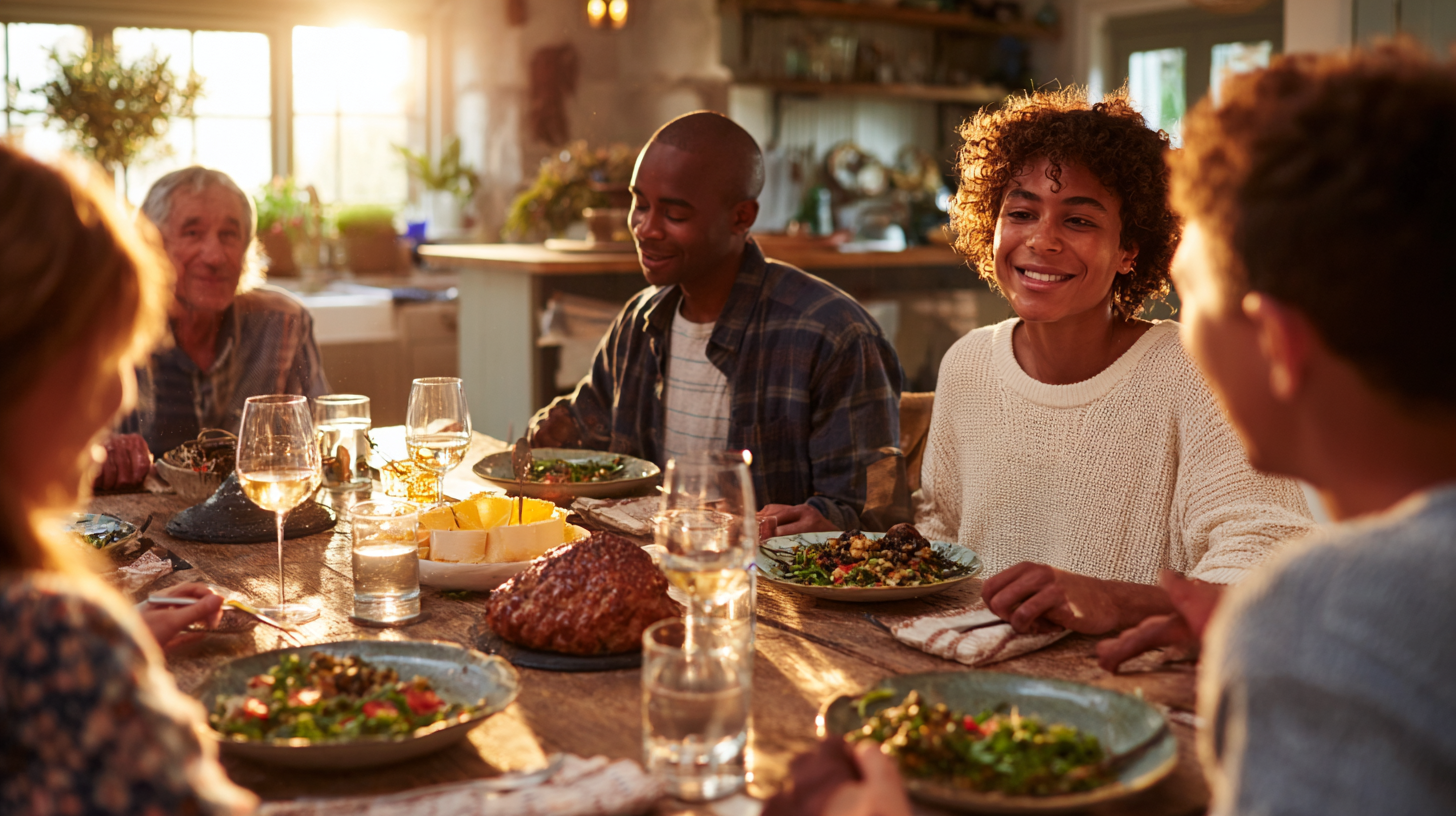
You know, when people first speak of family meals, they usually picture only the pleasantness of soup and conversation, and not at all the darker paths a young person might avoid by simply coming to the table. Yet researchers, with their unromantic charts and numbers, keep finding the same thing: children and teens who eat regularly with their families are less likely to smoke, to drink heavily, to misuse drugs, or to fall into other risky behaviors than those who rarely appear at the evening meal (Fulkerson et al., 2006; Skeer & Ballard, 2013). It seems almost too simple, does it not? But the evidence is stubborn, and, when you think of the life of the household, quite reasonable.
First, the table places a gentle frame around the day. When a young person knows that supper is at six, and that attendance is expected unless there is a clearly stated reason, certain temptations are quietly fenced out. It is far more difficult to linger in questionable company, or fill the afternoon and evening with idle wandering, when one must be home at a particular hour and will be missed if not present. A teen who knows that a parent will look up at the clock, see an empty chair, and ask questions is less free to drift into the kind of mischief that often begins in unstructured time.
This is not a matter of spying or suspicion, but of simple presence. The very act of seeing one another daily provides what scholars like to call “informal monitoring.” At the table, you notice if your child’s eyes are unusually dull, if their laughter is a little too loud or strained, if a new group of friends is forever mentioned with evasive details. You do not need to conduct an interrogation; an offhand remark—“You seem tired tonight, is everything well?”—can open the door. Many parents have first suspected that something was amiss not because of a dramatic scene, but because the manner of a son or daughter at supper was different, off-key, not quite like themselves.
These regular glimpses also make it harder for secret habits to grow. A teen who is drinking, smoking, or experimenting with other substances will have a more difficult time hiding it if he or she must meet a parent face to face every evening, in good light, at close quarters. The smell of smoke or alcohol, the redness of the eyes, the unusual hunger or lack of appetite—all these are more readily seen at the table than in the quick exchanges of a hurried morning or late-night return. The meal becomes, in this sense, a daily safety check, kindly but steady.
Beyond simple observation, the table gives a natural setting for the sort of conversations that prevent folly before it begins. If you attempt to lecture a young person about drugs or unsafe relationships out of nowhere, at a moment already charged with emotion, you will likely meet a wall of resistance. But when these topics arise gradually over plates and cups—perhaps prompted by a story on the news, something that happened at school, or a cousin’s misadventure—they can be discussed with far less heat. You might say, “What do you think led him to that choice?” or “How would you have handled it?” and listen before offering your counsel. In this way, values are not thrown at your children; they are woven into everyday talk.
Studies have found that teens who report frequent family meals also say their parents know more about their friends, their whereabouts, and their troubles (Fulkerson et al., 2006). This knowledge is not gained by prying questions delivered like a magistrate’s examination, but by the easy talk of the table. One evening you hear about a new friend; the next, about a party; another night, about pressure to vape or drink. Because the conversation happens in little pieces, over time, it feels less like surveillance and more like shared life. And when a young person feels known in this way, they are less likely to seek belonging in the arms of those who would do them harm.
You and I have both observed that risky behaviors rarely arise from a single bad decision made in a calm and happy heart. They sprout most readily in ground that is lonely, angry, or bored. Here the table’s habit of togetherness does some of its best quiet work. A child who has laughed over spilled gravy, shared stories about a teacher’s oddities, or received sympathy for a hard exam is less likely to feel utterly cut off from the household. This sense of belonging—“These are my people; I matter here”—has been linked in many studies with lower rates of substance use, violence, and self-harm (Resnick et al., 1997). It is difficult to throw oneself away when one is daily reminded that one is wanted.
There is also the small but mighty matter of routine. A home where meals occur at roughly the same time, where evenings have some recognizable shape, naturally leaves less space for chaos. After supper there may be dishes to wash, a board game to play, homework to finish, or a walk to take. These may seem like trifles, scarcely worthy of mention, yet they occupy the hours in which many poor choices are commonly made. A teen who expects to clear the table, then review tomorrow’s test with a parent, simply has fewer empty hours in which to be swept along by a friend’s reckless suggestion.
Some parents fear that insisting on attendance at meals will drive their older children away—that it will seem old-fashioned, even oppressive. But when the table has long been a place of listening rather than constant scolding, most young people accept its claims with surprising good will. They may grumble a little, but inwardly they know it is a sign of care, not control, that someone expects to see their face each evening. And if you offer a reasonable flexibility—understanding that a rehearsal, a practice, or an occasional friend’s birthday may excuse them—they are more likely to honor the general expectation.
Another curious thing researchers have noticed is that even after accounting for matters such as income, school quality, and neighborhood, the link between shared meals and reduced risky behaviors still remains (Skeer & Ballard, 2013). This suggests that it is not merely a sign of a “good family” that eats together, but that the act of eating together itself does something. I suspect it is because the meal is one of the last daily rituals left to us in which the body and soul are tended at the same time. The same plate that offers nutrition to growing bones also brings counsel to an uncertain mind and comfort to a troubled heart. When this happens again and again, the appetite for cheap thrills is, in some measure, displaced by the steadier satisfaction of being rooted in a family.
You might object, quite reasonably, that not every child in a household with regular dinners grows up wise and prudent. That is true. Human beings are not so easily managed as that. There will always be some who, in spite of love and good habits, lose themselves for a season. Yet even in such cases, the memory of the table can draw them back. A young man or woman who has grown accustomed to being welcomed at a familiar chair, to being asked after with real interest, carries that memory into their wanderings. When trouble comes—and it so often does—they are more likely to return to the one place in the world where they have felt both known and accepted. Many a parent has received a late-night confession that began with words like, “Can we talk?” spoken over a hastily reheated plate of leftovers.
In contrast, where there has never been such a habit, or where meals have been marked only by sharp words and cold silence, a child in trouble may have no clear picture of home as a refuge. That is why it matters so much that, imperfect as we are, we strive to keep the table as a place where truth and mercy meet. You may not always know the perfect thing to say; you may be clumsy in your efforts to discuss the dangers of drinking, drugs, or sexual pressure. But if your child has learned that the table is a safe place for difficult talk, your very willingness to hear them out will do more good than the most polished speech.
We should also consider how mealtime talk can gently prepare young people to face peer pressure before it arrives in full force. When they are still in the safer years of childhood, you might use stories—drawn from your own youth, from books, or from others’ experiences—to discuss what happens when people choose the wrong companions, drive under the influence, or join in cruelty for the sake of fitting in. These are not to be told in a spirit of horror or gossip, but as case studies: “What else could he have done? What might have happened if someone had spoken up?” As children grow older, they will recognize similar situations and, remembering those calm discussions, feel more equipped to stand apart from the crowd.
Of course, not every meal will be a seminar on moral courage. That would weary anyone. Most of the time, conversation will wander over ordinary things—pets, weather, bits of amusement from the day. That is as it should be. But every now and then, when life presents a fitting example, you can allow the talk to turn to these more serious matters, and because the table is already a place of ease, the seriousness will not feel like an invasion.
It is also wise to make room at your table, now and then, for your children’s friends. By welcoming their companions, you see for yourself the characters that are shaping your child’s world, and those companions, in turn, get a glimpse of a home where eating together is normal and kindness is customary. Some young people, accustomed only to hurried meals or solitary snacking, are deeply struck by the sight of a family sitting down together, passing dishes, and listening to one another. Without a word of preaching, your household offers them an example of another way to live. And for your own child, having friends received with hospitality makes it easier to keep home at the center of their life rather than some distant corner they visit only to sleep.
None of this requires perfection, elaborate menus, or expert speeches. It asks only for a reasonable steadiness: a table where people mostly show up, food that is honest if not magnificent, and a tone that is more welcoming than severe. In those unremarkable conditions, the remarkable often takes place. Foolish plans are quietly abandoned because a parent’s raised eyebrow at supper betrayed concern. Dangerous friendships fade because the warmth of home makes their excitement seem hollow. Risks that once glittered in the afternoon light appear shabby in the plain brightness of the family table.
As these dangers are held at a distance, the way is opened for the more cheerful fruits of the shared meal to grow. A young person who is not consumed with secret habits or fearful of being found out is freer to hear guidance about school, work, and health, and to practice the modest disciplines that will carry them into adult life. From this same table where temptations are quietly restrained, you can begin to shape practical routines and choices that make family suppers not only protective, but pleasantly possible amid the tangle of modern schedules.
Practical strategies for successful family meals
Turning the good intentions of family meals into steady practice can feel daunting, especially when work hours are long, children’s activities are many, and everyone seems to be moving at a different speed. Yet even in a busy home, simple, thoughtful strategies can make shared suppers more likely than not. Instead of picturing an idealized scene that never quite materializes, it is often better to begin where you are—with the people, time, and food you already have—and gently bend your routines toward the table.
One of the most helpful steps is to choose a “usual” time for the main family meal and guard it as you would any other important appointment. The hour itself may differ from household to household—some may find early suppers best, others a later evening meal—but the regularity matters more than the clock. When everyone can assume, for instance, that most nights the table will be set around six-thirty, they can begin to plan around it. Practices can be scheduled a little earlier, errands finished a bit sooner, and the scattering of the household slowly gathered into a pattern of daily togetherness.
Of course, real life rarely cooperates perfectly. Shifts change, traffic delays, and certain seasons of the year bring extra busyness. In these times, flexibility is your ally, not your enemy. Perhaps the whole family cannot gather every evening; perhaps some weeks it is three nights instead of five. Rather than abandoning the habit altogether, you might ask, “On which specific days this week can we all sit down?” Naming those days aloud—Sunday, Tuesday, Thursday, for example—and writing them on a family calendar helps everyone treat them as fixed points in the week, even if the other days must take a different shape.
Planning what you will eat can ease much of the strain. Many parents find it helpful to sketch a simple menu for the week, not as a rigid law but as a guide. It may be as plain as “soup and bread Monday, beans and rice Tuesday, pasta Wednesday, leftovers Thursday, simple stir-fry Friday.” Seeing these meals laid out ahead of time reduces the last-minute scramble, saves trips to the store, and makes it easier to ensure a reasonable balance of nutrition. When you know that Tuesday is the day for beans and rice, you can soak the beans the night before, or at least know what to pull from the pantry when you walk in the door.
Once you have a rough plan, simplifying the actual cooking can make all the difference. You need not be a skilled chef to feed a family well; in fact, the humbler the dishes, the more likely the habit will endure. One-pot meals, slow-cooker stews, sheet-pan roasts, and hearty salads built from sturdy greens and canned beans can be prepared with little fuss and minimal cleanup. If you keep a short list of dependable recipes that everyone tolerates and you can make almost without thinking, the question “What’s for dinner?” becomes less of a daily crisis and more of a gentle rotation.
Batch cooking can further lighten the load. On a quieter day—perhaps the weekend—you might cook a large pot of soup, stew, or grain and divide it for later in the week. Leftovers can be refreshed with small additions: extra vegetables, a handful of herbs, a sprinkle of cheese. Far from being a sign of failure, serving the same dish twice in a week can be a sign of wisdom, freeing time that might otherwise be lost in constant chopping and stirring. The aim is not novelty at every meal, but steadiness.
Involving others in preparation and cleanup turns the meal from a solitary burden into a shared work. Even a small child can carry spoons, fold napkins, or wash a few sturdy vegetables under running water. Older ones can learn to chop, stir, and follow simple recipes. You might assign “kitchen nights,” where each person has a role—one sets the table, one helps cook, another clears and washes dishes. This not only speeds the work but also allows each member of the household to feel that they are contributing to the common life, rather than appearing at the table as mere guests.
Some families find it fruitful to create a few small rituals that make the table inviting without becoming elaborate. It might be as simple as lighting a candle, saying a short grace, or asking each person to share one good thing from the day. These repeated gestures signal to the mind and body that this time is set apart from the rest of the day’s hurry. They add a quiet dignity to even the most ordinary meal—scrambled eggs and toast can become a genuine occasion when it is framed with gratitude and the expectation of being heard.
Setting boundaries around distractions is another practical strategy. If everyone arrives at the table with a phone in hand and a screen flickering in the corner, conversation will be thin and attention scattered. You might adopt a household rule that phones remain in another room during the meal and that the television stays off. At first there may be fidgeting; silence can feel strange to those accustomed to constant noise. But in that quiet, eyes begin to lift from screens to faces, and the habit of listening has a chance to grow.
Conversation itself can be gently cultivated. Not every parent feels naturally skilled at drawing others out, yet simple questions can go a long way. You might ask, “What made you laugh today?” or “Was there anything that surprised you?” When a child or spouse answers, allow them room to finish without hurrying them or turning every statement into a lesson. Over time, you will learn which questions open hearts and which close them, and the table will become known as a place where words can be shared safely.
At times, you may notice that conversation is repeatedly derailed by criticism, sarcasm, or sensitive topics that inflame rather than enlighten. It can help to set gentle guidelines: perhaps deciding that certain contentious matters will be discussed at another time, or that each person will be allowed to finish before others respond. You might even say, “At this table, we will try to build one another up,” and then model what that looks like in practice. The goal is not to ban all disagreement—that would be impossible and unhealthy—but to keep the table from becoming a battleground where appetites and relationships are both spoiled.
For some households, the greatest barrier to shared meals is not conflict, but timing. Work may extend late into the evening, or children’s activities may cut across the dinner hour. In such cases, creativity is required. Perhaps breakfast becomes your main gathering, with everyone meeting at the table for half an hour before the day begins. Or perhaps weekends are protected as special times when a longer meal—Saturday brunch or Sunday supper—draws the family together, even if weekday evenings are more scattered. The essence of the habit lies not in the clock, but in the consistent act of sitting down together over food.
There may also be seasons when your table expands to include extended family, neighbors, or friends who lack a household of their own. Opening your door in this way can deepen the richness of mealtimes and widen your children’s sense of community. It can, however, also add work, so it is wise to keep such hospitality simple—perhaps a pot of soup and bread rather than a many-course feast. When guests see that the heart of the gathering is fellowship rather than display, they are often more at ease, and your own family is less burdened by the fear of not measuring up.
As you put these strategies into practice, it is helpful to remember that the aim is gradual change, not instant perfection. There will be evenings when the plan collapses, when tempers flare, or when everyone ends up eating at different times. Instead of taking these as signs of failure, you might see them as part of the process—as evidence that you are pushing against strong currents. The important question is not, “Did we manage a flawless dinner tonight?” but, “Over the course of this week or month, are we drawing a little closer to the table than before?”
You may find it useful to pause every so often and ask yourself: What small adjustment would make shared meals more likely in the coming weeks? Is it a simpler menu, a clearer expectation about attendance, a firmer boundary around screens, or a more generous sharing of kitchen work? Each home will answer differently, and the answers may change as children grow and circumstances shift. The very act of asking, of looking with fresh eyes at your habits, can stir a deeper curiosity: How might these ordinary plates and cups be shaping our health, our character, and our sense of belonging in ways we have scarcely noticed?
If you allow these questions to settle in your mind, you may begin to look at the evening hour differently. The choice between one more task and a half-hour at the table, between a quick meal in front of a screen and a slower one in the presence of those you love, becomes less trivial and more weighty. What stories are silently being written at your table—or in its absence? What kind of memories will your children carry into their own homes one day: the habit of eating alone in haste, or the expectation that food and fellowship rightly go together? As you consider these things, a quiet thirst for understanding may grow, prompting you to watch more closely, to read more widely, and to experiment more boldly with the humble but powerful practice of gathering for a daily meal.
- How often should our family aim to eat together to see health benefits?
- Research suggests that families who share a main meal at least three to five times per week tend to see noticeable benefits in physical health, emotional well-being, and reduced risky behaviors in children. More frequent meals can deepen these effects, but even starting with one or two regular shared meals is a meaningful step forward.
- What if our schedules are too busy for regular dinners?
- If evening meals are difficult, consider making breakfast or weekend brunch your main shared meal. You can also choose specific days each week for family dinners and protect those times, accepting that not every day will be perfect but that a steady pattern still brings real benefits.
- Do meals have to be home-cooked and elaborate to be worthwhile?
- No; the health and relational benefits come primarily from the shared time, not from fancy recipes. Simple, repeated meals—soups, beans and rice, salads, eggs, and whole-grain bread—can provide excellent nutrition without exhausting the cook or the budget.
- How can we manage picky eaters without constant conflict?
- Serve small portions of new or disliked foods alongside familiar favorites, and encourage a “one bite” rule rather than forcing children to finish everything. Keep the tone calm, avoid turning food into a power struggle, and offer repeated, low-pressure exposure over many meals so tastes can change gradually.
- What should we do about phones and screens during family meals?
- Many families find it helpful to agree that phones stay off the table and the television remains off during meals, so everyone can focus on conversation. This simple rule protects the sense of togetherness and makes it easier to notice how each person is really doing.
- How can we keep conversation positive and meaningful at the table?
- You can introduce gentle prompts like “What was one good thing and one hard thing from your day?” and practice listening without rushing to judge or correct. If certain topics always spark arguments, agree to save them for another time, and let the meal be a place for encouragement, everyday stories, and honest but respectful sharing.
- Is it too late to start family meals if our children are already teenagers?
- It is not too late; teens can still benefit greatly from the structure, attention, and care that shared meals provide. Begin with realistic expectations—perhaps a few scheduled dinners each week—and explain that this change is meant to strengthen the family, then let the new habit grow through consistency rather than force.
Ashland Sabbath Chapel Ministries
Beside our live streamed church services, all are welcome to attend our church in person each Saturday beginning 10:00 AM Central Time by going to 2425 Owens Rd., Ashland, AL 36251. There is no cost and any donations are strictly voluntary.
For questions, call +2563547124.