Come join Ashland Sabbath Chapel Ministries each Saturday for live streamed church services. Bible Study begins at 10:00 AM Central Time and Sermon at 11:00 AM. Visit Our YouTube channel and watch from home!
Think of your health journal as that one friend who actually remembers what’s been going on with your body, even when you don’t. You know how, the second you sit down in a doctor’s office and they ask, “So when did this start?” your brain suddenly forgets the last three months of your life? A health journal quietly fixes that. It turns all those random aches, moods, and strange little episodes into a clear story instead of scattered, half-remembered moments.
The key is to treat it less like homework and more like honest observation. You’re not trying to write a novel; you’re just gathering clues. Every time something feels “off”—a headache that lingers, a burst of energy out of nowhere, a night of terrible sleep—you jot it down. Over time, those notes stop looking like noise and start forming patterns. That’s where things get interesting.
Start with the basics: what, when, and how strong. What symptom showed up? When did it happen? How intense was it on a simple 1–10 scale? Add a few quick details: what you were doing, what you ate, how you slept, any stress you were under. So a single entry might look like: “3 pm, sharp headache, 6/10, after skipping lunch, slept 5 hours, stressful meeting earlier.” Nothing fancy, but that one line already tells you more than “I get headaches sometimes.”
After a week or two of this, you’ll notice how much clearer things become. Instead of thinking, “I’m tired all the time,” you might see that your worst days cluster after nights of less than six hours of sleep. Or you’ll realize your stomach acts up mostly on days when you grab fast food twice. That’s the power of seeing your days side by side. Your brain is good at remembering dramatic moments; your journal is good at catching the quiet, repeating ones.
This is where self-reflection comes in, but in a practical, down-to-earth way. You’re not just listing symptoms; you’re asking, “What seems to come right before this?” and “What usually follows?” For example, maybe you notice your joint pain shows up more on cold, damp days, or that your anxiety spikes the day after you have caffeine late at night. You’re connecting dots your memory alone would never line up neatly.
One really helpful trick is to track a few consistent categories every day, even if you feel mostly fine. For example:
- Sleep: how long and how restful it felt
- Energy level: maybe just “low, medium, high”
- Mood: a quick word or two, like “calm,” “irritable,” “flat,” or “hopeful”
- Movement: any walking, stretching, or workout you did
- Food notes: not every bite, just anything unusual or heavy
- Symptoms: anything that stands out, even if it seems small
When you log these for a few weeks, patterns often jump out. You might realize your mood consistently dips in the late afternoon, or that you feel bloated every time you eat a certain type of bread. It’s not that the journal magically fixes anything—it just shines a light on what’s happening so you’re not guessing anymore.
A lot of people only write when something is wrong, but tracking “good” days matters just as much. On those days, note what went well: solid sleep, light dinner, a walk outside, less screen time before bed. Those become your personal templates. Instead of vague advice like “live a healthier lifestyle,” you can say, “I tend to feel my best when I get at least seven hours of sleep and take a 15-minute walk after lunch.” That’s specific, and it’s based on your actual life, not somebody else’s routine.
It helps to think like a curious investigator instead of a harsh critic. If you have a week of low energy, you’re not judging yourself; you’re asking, “What’s different this week?” Maybe you started staying up later, or you’re under a deadline at work, or you added a new medication. Your health journal lets you lay those factors out side by side instead of carrying them all in your head. You’re basically giving yourself better data to work with.
Realistically, you won’t log every detail perfectly, and you don’t need to. Consistency beats perfection. Even a few quick lines most days will give you more insight than trying to reconstruct the last month from memory. Over time, that steady tracking helps you see your own rhythms—how your body responds to seasons, stress, travel, hormones, or changes in routine. You start to notice, “This isn’t random; my body actually has a pattern here.”
And that’s where the deeper value comes in: you’re not just recording discomfort; you’re learning your body’s language. Those little notes become a map of your personal wellness landscape—what supports you, what drains you, and what quietly nudges your symptoms up or down. Instead of feeling at the mercy of how you happen to feel on any given day, you’ve got a record you can look back on and say, “I’ve seen this before. I know when it tends to show up, and I have a better idea what might help.”
Improving communication with healthcare providers

Your health journal really earns its keep when you walk into a doctor’s office. Most of us sit down, stare at the wall, and then answer every question with, “Uh…a few weeks? Maybe longer?” That’s not your fault. The days blur together. But your journal doesn’t forget. It turns your foggy timeline into clear, dated, no-nonsense facts your doctor can actually use.
Think about the questions they always ask: When did it start? How often? How bad is it? What makes it worse? What helps? If you’re trying to pull all that from memory, you’ll miss half of it. But if you’ve been jotting things down, you can say, “Here—this is the last six weeks.” It’s the difference between saying, “My stomach hurts a lot,” and, “I’ve had stomach pain 4–5 times a week, usually in the evening, often after heavy or greasy meals, pain level 7/10.” One of those answers sends your doctor guessing. The other one gives them a trail to follow.
Before an appointment, you can flip through your health journal and pull out the parts that matter most. You don’t need to bring your whole life story—just the pages that cover the last month or two, or since your symptoms started. It helps to make a short, calm list the night before:
- Main concerns: the top 2–3 symptoms bothering you now
- Timeline: when you first noticed each one and how it has changed
- Patterns: anything that seems to trigger or ease them
- Medications/supplements: dose, how long you’ve been taking them
- Questions: what you want to ask before you walk out of that room
That last part—questions—is easy to forget when you’re sitting on the cold exam table in a paper gown. You think, “I’ll remember,” and then you don’t. If you use your journal as a running place for questions (“Is this normal?” “Could this be from my new meds?” “Should I see a specialist?”), you won’t have to trust your nerves or your memory. You just open the page and read them off.
A health journal also helps you sound more sure of yourself without being dramatic. You’re not saying, “Everything is terrible all the time.” You’re saying, “Over the last three weeks, I’ve had shortness of breath on six different days. It tends to show up when I climb stairs. It lasts about five minutes, then fades.” That kind of steady detail is what lets your provider separate urgent problems from everyday noise. It’s not about complaining; it’s about giving them a clear picture of your real life.
Sometimes doctors ask about things that seem unrelated: sleep, stress, food, bowel habits, your period, how much you move. If you’ve been tracking those lightly—just a line or two each day—you don’t have to guess. You can say, “My sleep’s been under six hours for most of this month,” or “My anxiety spikes the day after I drink more than two coffees.” You might not think of those as important, but they’re often the missing pieces your provider needs to see the whole pattern of your wellness.
Your journal also gives you a way to talk back, gently but firmly, if you feel brushed off. If someone says, “It’s probably nothing,” and you’re not so sure, you don’t have to argue from feelings alone. You can say, “I get that, but I’ve logged this for eight weeks. The pain is getting more frequent and more intense. It’s gone from 3/10 once a week to 7/10 three times a week. That worries me.” That’s not being difficult. That’s being precise. The numbers and dates you’ve written down give your concerns more weight.
On the flip side, your health journal can save you from overreacting to one bad night or one weird day. Let’s say you’re convinced your new medication is wrecking your sleep. You look back and realize: no, the trouble started two weeks before the prescription, right when work got chaotic and you stopped eating dinner at a normal hour. That kind of self-reflection can keep you from chasing the wrong problem or blaming the wrong thing in the appointment.
After you leave the office, don’t just stuff the visit in your memory and hope it sticks. Use the same pages to record what the doctor said: the diagnosis they’re considering, tests ordered, next steps, and anything you need to watch for. Write down the exact way they explained things, in your own words. Later, when a friend or partner asks, “So what did they say?” you won’t be trying to dig the details out of thin air.
This becomes even more important when you’re seeing more than one provider. Maybe you’ve got a primary doctor, a therapist, and a specialist. Each one sees you in a narrow slice. Your journal is where all of those slices meet. You can bring it along and say, “Here’s my medication list. Here’s what the cardiologist said last month. Here’s what changed since then.” You’re not relying on one clinic’s notes to talk to another. You’re carrying your own record of your body and your care.
And if you ever feel small in that room—overwhelmed by big words, short appointment times, and the sense that everyone else knows more than you do—your health journal is a quiet way of saying, “I’m paying attention. I live in this body every day. I have something real to bring to this conversation.” You’re not just a patient on a chart. You’re the one person who sees the whole story, from the first twinge in the morning to the last ache before you fall asleep. Your notes help your provider meet you where you actually are, instead of where a fifteen-minute visit guesses you might be.
Supporting mental and emotional well-being
Your mind keeps its own kind of medical chart—half-remembered fears at 2 a.m., flashes of dread on the drive to work, that weird sense of “something’s wrong” you can’t quite name. A health journal gives all of that a safe, private place to land. It’s like telling your nervous system, “Okay, I hear you. Let’s put this down somewhere so you don’t have to carry it alone.”
Most of us try to think our way out of stress. We replay conversations, second-guess decisions, scroll until our thumb aches. But your brain is a lousy storage unit. It keeps everything jumbled. When you write, you’re not just dumping feelings on a page; you’re sorting. You’re taking a vague cloud of “I feel awful” and turning it into something you can actually look at: “I feel on edge after meetings with my boss. I feel calmer after walking outside. I get this heavy, hopeless feeling when I scroll social media before bed.” That’s the beginning of emotional clarity.
There’s research backing this up. Psychologist James Pennebaker and others have shown that expressive writing—just putting honest thoughts and feelings into words—can reduce stress, improve mood, and even support immune function over time [1]. The magic isn’t in sounding poetic; it’s in being real. Your sentences can be choppy, messy, ungrammatical. What matters is that you’re not leaving the feelings swirling unspoken in your head.
The trick is to fold this gently into the self-reflection you’re already doing about symptoms. When you jot down, “Woke up with chest tightness, 6/10,” add a line or two: “Emotionally: tense, bracing for the day. Kept thinking I’m behind on everything.” That way, your journal shows not just what your body is doing, but what your inner life feels like at the same time. Over a few weeks, those little emotional footnotes start to speak louder than the symptoms themselves.
You might notice patterns you didn’t expect. Maybe your migraines aren’t just tied to weather or caffeine; they cluster after big arguments or long stretches of people-pleasing. Maybe your IBS flares not just after greasy food, but after weekends where you never got any time alone. The journal holds those details side by side: the pain, the day, the people, the thoughts circling in your head. You stop seeing your body as a separate, malfunctioning machine and start seeing the full system—how stress, relationships, sleep, and mood all braid together into your wellness.
And being honest doesn’t mean being dramatic. Some days your entry might be nothing more than, “Low-grade sadness all day. No crisis, just gray.” That’s important data. Persistent “gray” deserves as much attention as the big breakdowns. Writing it down keeps you from brushing it off with, “I’m just tired,” for the twelfth week in a row. If you later decide to talk to a therapist or doctor, you’ve got dates, words, and examples instead of a vague, “I don’t know, I’ve been off for a while.”
If the word “journaling” makes you picture teenage diaries and heart-shaped locks, drop that image. What you’re doing here is more like a series of brief check-ins. A simple structure you can use is three quick prompts at the end of each day:
- “What felt heavy today?” (anxiety spikes, moments of anger, mental loops)
- “What felt light or good?” (even small things: a joke, a quiet walk, a decent cup of coffee)
- “What helped, even a little?” (calling a friend, stepping away from your desk, deep breaths, music)
None of these have to be long. One line per question is enough. Over time, the “what helped” list becomes one of the most valuable things in your notebook. When your mood drops and everything looks pointless, you don’t have to invent coping tools from scratch; you can flip back and see what has actually, concretely helped you in the past. That’s not a motivational quote—it’s your own data, from your own life.
Your journal also gives you a safe place to say the unsayable. The things you’re afraid will sound silly, selfish, or overdramatic out loud: “I’m terrified this symptom means something fatal.” “I feel guilty every time I say no.” “I’m angry that my body can’t do what it used to.” You might never show those sentences to anyone. You don’t have to. But when they’re written down, they stop being this huge, formless threat. You can read them, breathe, and think, “Okay. That’s what’s in there.” That alone lowers the pressure inside the system.
And once you can see those thoughts, you can gently question them. You don’t have to turn your journal into a self-help workbook, but a simple follow-up can be powerful: “Is this completely true?” or “What would I say to a friend who wrote this?” That tiny bit of distance is often enough to take an all-or-nothing belief and loosen its grip. Cognitive behavioral therapy (CBT), one of the best-researched approaches for anxiety and depression, leans heavily on exactly this kind of written reflection—catching thoughts, checking them, and experimenting with new ways of responding [2].
The other hidden gift of a health journal is that it doesn’t just catalog what hurts; it captures what’s growing. When you write only during crises, your pages become a museum of everything that ever went wrong. But if you deliberately note small wins—“Went for a ten-minute walk even though I wanted to stay in bed,” “Didn’t snap at my partner even when I was exhausted,” “Anxiety showed up but it didn’t run the whole day”—you’re building a record of resilience. These aren’t Instagram wins. They’re real, private, quiet shifts in how you move through your life.
Psychologist Barbara Fredrickson’s work on positive emotions suggests that even brief moments of gratitude, joy, or calm can help “broaden and build” your capacity to cope over time [3]. Your journal is where you name those brief moments before they vanish. Not to force yourself into toxic positivity, but to avoid letting your hardest ten minutes erase your best ten minutes from memory.
On tougher days, when you’re convinced you’ve made no progress at all, flipping back a month or two can be sobering in the best way. You’ll see entries like, “Cried every morning this week. Can’t see a way out,” and compare them to more recent ones: “Rough day, but it passed,” or “Felt anxious, took a walk, was okay by evening.” That’s change. Not cinematic, not linear, but real. Without the pages, your brain tends to flatten everything into “I’ve always been like this” or “Nothing ever gets better.” The journal quietly disagrees, with receipts.
And if you’re already working with a therapist, counselor, or support group, your health journal can deepen that work without turning your sessions into endless recaps. Instead of spending half the time saying, “Wait, what happened Tuesday?” you can skim your entries beforehand, circle a few moments that felt charged—an outburst, a numb evening, a surprising good day—and bring those in. You arrive not as a blank slate, but as someone who’s been paying attention to your inner weather between visits.
There’s no single “right” tone for these pages. Some days you might be blunt and factual: “Woke up sad, stayed sad.” Other days you might drift into metaphor or memory. Both count. The only rule worth keeping is this: don’t write to impress your future self. Write what feels true in the moment. That’s the stuff that will matter later, when you’re trying to understand what your mind and heart have been trying to say beneath all the noise of appointments, obligations, and notifications.
Over time, the act of picking up the pen becomes its own kind of signal to your nervous system: we’re listening now. We’re not shoving this down or numbing it out; we’re going to look at it, gently, for a few minutes. That’s a radical kind of care in a world that keeps telling you to move faster and feel less. You’re using simple tools—paper, ink, five honest minutes—to rebuild a steady relationship with yourself. Not a perfect one, not a cured one, but a truer one. And that, quietly, is one of the most powerful supports for your mental and emotional well-being that you can build with your own two hands.
References
- [1] Pennebaker, J. W. (1997). “Writing about emotional experiences as a therapeutic process.” Psychological Science, 8(3), 162–166.
- [2] Beck, J. S. (2011). Cognitive Behavior Therapy: Basics and Beyond (2nd ed.). Guilford Press.
- [3] Fredrickson, B. L. (2001). “The role of positive emotions in positive psychology: The broaden-and-build theory of positive emotions.” American Psychologist, 56(3), 218–226.
Enhancing goal setting and habit building
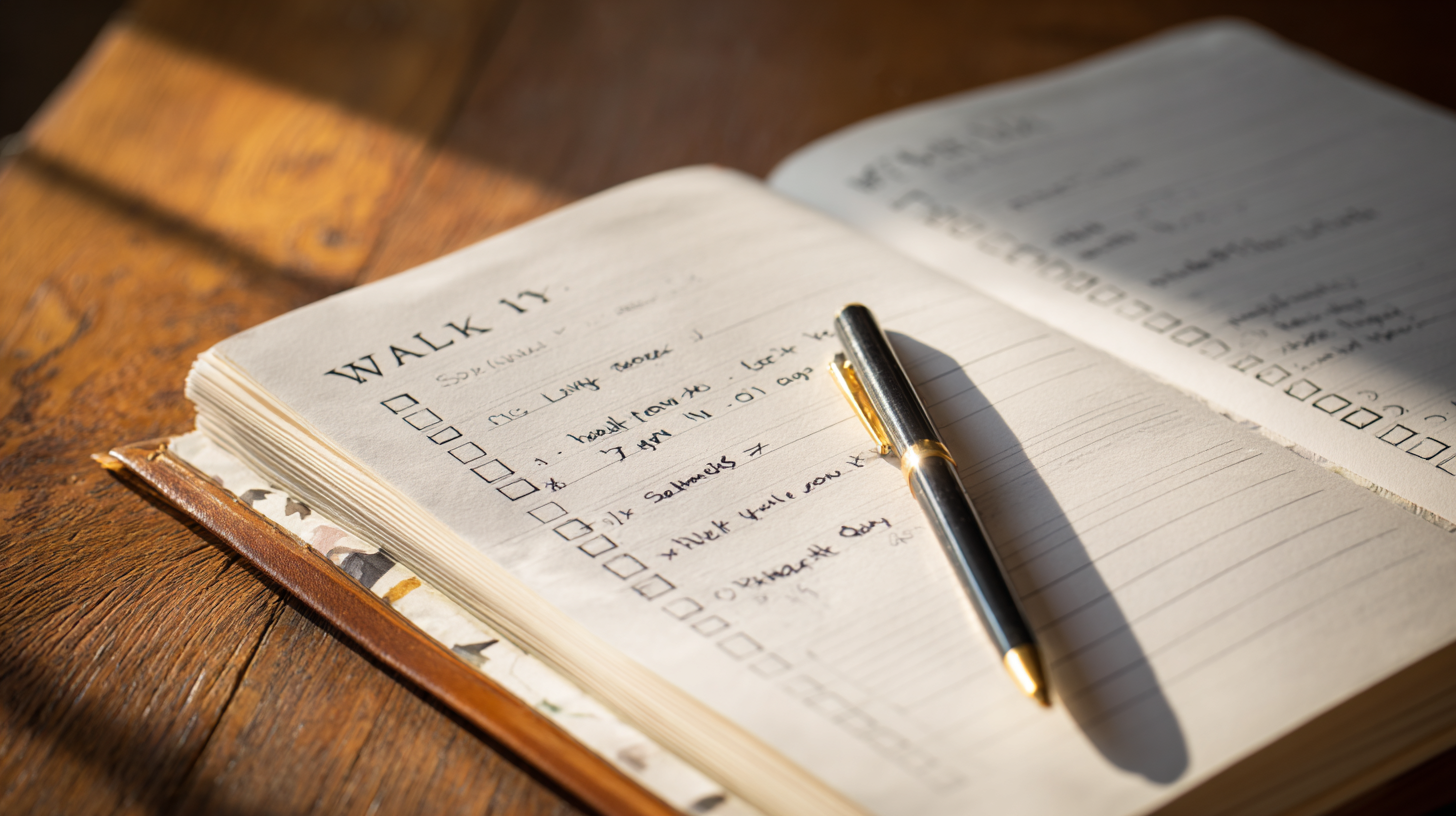
You know how every January we all swear we’re going to “get healthy,” and by February we’re eating snacks over the sink, wondering what happened? The problem usually isn’t willpower; it’s fuzzy goals and zero feedback. A health journal quietly fixes both. It turns “I should really take better care of myself” into specific, visible actions with a real-world scoreboard attached.
Think of it like this: if your life is a long-distance hike, your habits are the steps, and your journal is the trail map. You can wander in the right general direction for a while just by feel, but if you want to actually reach a particular ridge—better sleep, less pain, steadier mood—you need markers. You need to know, “Did I move today? Did I drink water? Did I go to bed when I said I would?” Not in a moral sense—no gold stars, no shame—just in a clear, honest record.
The mistake most people make is trying to overhaul everything at once. “From now on I’ll sleep eight hours, meditate daily, cut sugar, run three miles, and stretch for thirty minutes.” That kind of plan looks impressive on paper and collapses on Tuesday. Your journal is where you can do something smarter: pick one or two tiny, concrete habits and let them earn their place in your routine before you add more.
For example, instead of “I’m going to exercise more,” you might write:
- Walk for 10 minutes after lunch, at least 4 days this week.
- Lights out by 11:00 p.m. on weeknights.
That’s it. Not heroic, just real. Then, in your daily entry, you give each habit a quick check-in: “Walk: yes/no. Lights out by 11: yes/no.” If you like visuals, you can even mark them with a simple “Y” or “N” in the margin. Over a couple of weeks, those tiny marks start to form a pattern, and the pattern is where the real story lives.
This is where self-reflection stops being abstract and gets practical. When you look back over two weeks of entries and see, “Huh, I only hit my walk goal on low-stress days,” that’s useful. You’re not a failure; you’ve discovered that stress is the real barrier, not laziness. Now you can tweak the plan: maybe move the walk to early morning before the day grabs you, or shorten it to five minutes on heavy days. The journal becomes a quiet lab where you experiment with your own life.
There’s a simple rhythm that works well for a lot of people:
- At the start of the week: write 1–3 small health goals, max.
- Each day: note what you actually did, not what you meant to do.
- End of the week: spend five minutes reading back and asking, “What helped? What got in the way? What’s worth keeping?”
Notice that last part: you’re not asking, “Why am I like this?” You’re asking, “What happened out here in the real world?” Big difference. If you see that on nights you scroll your phone in bed you blow past your sleep goal, you don’t have to declare yourself a lost cause. You can say, “Okay, the phone is a problem. What’s one small boundary I can try?” Maybe you plug it in across the room and write a two-line wrap-up of the day in your journal instead. You’re not waiting for motivation to show up; you’re changing the conditions of the game.
One of the strongest ways to use your health journal for habit building is to tie new behaviors to things you’re already doing. This is sometimes called “habit stacking,” but you don’t have to use the jargon. You just write: “After I do X, I will do Y.” For example:
- After I brush my teeth at night, I’ll stretch my back for 2 minutes.
- After I pour my morning coffee, I’ll drink a glass of water.
- After I sit down at my desk, I’ll take three slow breaths before opening email.
Then in your daily notes, you track how often those little add-ons actually happened. You’ll see some stick faster than others. That’s normal. The ones that keep failing aren’t proof you’re broken; they’re feedback that the pairing isn’t right, or the step is too big. Maybe you need to choose a different anchor, or shrink the habit so small it’s almost laughable. “Stretch for 30 seconds.” “One slow breath.” If it sounds too tiny to matter, it’s probably the right size to start.
Here’s where your journal quietly protects your sense of progress. The human brain is terrible at remembering small wins. If you’re changing your eating habits, for example, you’ll clearly remember the night you demolished a whole pizza. You probably won’t remember the three evenings you stopped at one slice or added a salad without making a big deal of it. But if you jot a quick note—“Dinner: 2 slices, plus salad” or “Craved snacks, waited 10 minutes, craving passed”—those moments don’t vanish. When you flip back through the pages, you can actually see the arc bending toward better choices, even if it doesn’t feel that way on a hard day.
This kind of tracking also helps you build goals that match your actual body instead of your fantasy one. Let’s say you decide you’re going to run three miles, three times a week. Bold. Then your journal fills up with entries like: “Knee pain 7/10 after run,” “Exhausted,” “Skipped because sore.” Instead of white-knuckling through and calling it discipline, you can use the data to renegotiate the goal: “Okay, looks like my joints aren’t thrilled about this. What if I walk-run intervals? Or just walk briskly for 20 minutes?” That’s not giving up; that’s calibrating. Your notes guard you from the kind of all-or-nothing thinking that usually ends in “nothing.”
Another powerful move is to give your goals reasons, not just numbers. Instead of “Lose 10 pounds,” your journal might say, “I want to be able to get up the stairs without gasping,” or “I want enough evening energy to play on the floor with the kids.” Then when you log your habits, you’re not just checking boxes; you’re connecting actions to a larger thread of wellness that actually matters to you.
For instance, you might write:
- Goal: Walk 10 minutes after dinner, 5 days this week.
- Why: Build stamina so hiking doesn’t wipe me out.
Then at the end of each day, a brief note: “Walked: yes, around the block. Tired but okay,” or “Skipped—raining, watched TV instead.” At the end of the week, you can see not just what happened, but whether the “why” still feels alive. If it doesn’t, that’s information. Maybe the goal needs a new reason, or maybe your real priority is somewhere else right now. Your journal keeps you honest with yourself without turning every misstep into a moral failure.
It also lets you design habits that change with your capacity. You’re not a machine; some weeks you’ll have more bandwidth than others. Instead of a single rigid target, you can use “tiers” of a habit and note which tier you hit that day. For example, in a corner of your page you could write:
- Movement: A = 30 minutes, B = 10 minutes, C = 2 minutes of stretching.
Then each day, jot “A,” “B,” or “C.” On a rough day, hitting “C” still counts as keeping the habit alive. The journal shows you that you didn’t abandon yourself; you just shifted down a gear. Over a month, that’s a very different story than the all-or-nothing graph most of us carry in our heads: perfect for three days, then nothing for three weeks.
One more thing your health journal quietly builds: integrity with yourself. Not in a heavy, moralistic way. Just the simple trust that when you say, “I’ll try this for a week,” you actually circle back and look at what happened. Even if the experiment “fails,” the act of revisiting it matters. You’re teaching your brain, “When I make small promises to myself, I check in. I don’t just let them fade into the background noise.” Over time, that makes new goals feel less like wishful thinking and more like genuine commitments, scaled to your real life.
There will be weeks when your pages are mostly misses and scribbles: “Didn’t walk. Ate whatever. Stayed up late. Again.” That’s not the moment to quit; that’s the moment to get curious. You can ask in the margins, “What changed this week?” Maybe a sick kid, a big project, a rough anniversary date. Once you see that, you can decide: “Okay, for weeks like this, my only non-negotiable is 5 minutes of stretching and taking my meds.” That’s not lowering the bar out of despair; it’s designing a backup plan for your hardest seasons so your habits don’t vanish completely.
Done this way, your health journal stops being a judge and starts being a training partner. It doesn’t scold, it reflects. It shows you the tiny steps you actually took, the conditions that helped, the ones that tripped you, and the places where your goals and your life finally shook hands and agreed on something workable. And slowly, almost quietly, those little checkmarks and notes become a body of evidence: not that you were perfect, but that you kept coming back to the work of caring for yourself in real, specific, doable ways.
Maintaining motivation and long-term accountability
At some point, the excitement of starting fades, and the real test begins: can you keep showing up for yourself week after week, when no one is grading you and no app is sending gold stars? This is where your health journal can quietly shift from being a place you write things down into a tool that keeps you grounded, honest, and moving forward—even if the progress is slower or messier than you hoped. Motivation will rise and fall. Accountability is what keeps you going in between.
One of the strongest motivators isn’t a number on a scale or a perfect streak—it’s proof that your effort is actually changing something. When you’ve been tracking for a month or two and you notice that your worst pain days are less frequent, or your sleep has nudged from four hours to six, that’s not just data. It’s a reason to keep going. If you’re feeling stuck right now, you might even pause and ask yourself: what would I discover about my own patterns if I could see the last six weeks of my life laid out clearly, instead of trying to remember them through frustration or fatigue?
To make that kind of accountability real, you can build simple “checkpoints” into your journal. Once a week—or even once every two weeks—set aside a small box or page titled something like “Review” or “What’s really happening?” There, you might jot down:
- One thing that seems to be improving (even slightly)
- One thing that feels stuck or worse
- One small adjustment you’re curious to try next
This kind of regular self-reflection keeps your health plan alive instead of letting it ossify into “rules” you either obey or break. You’re not just judging yourself; you’re studying yourself. You’re asking, almost like a scientist: “Given what I tried this week, what happened?” Imagine what might change if you treated your body less like a problem to fix and more like a living system you’re learning to understand.
Accountability can also be external without becoming pressure or shame. Your journal can act as a bridge between you and someone you trust—a partner, a friend, a coach, a therapist. You don’t have to hand over the whole notebook; you can choose what to share. Maybe once a week you skim your entries and send a quick message: “This week I walked three days, slept better two nights, and I’m still skipping breakfast more than I want.” When you know someone else is going to ask, “How did it go?” you’re more likely to check in with yourself first.
At the same time, your journal can protect you from the harshest kind of external judgment—your own. When you’re convinced you’re “failing,” flipping back can tell a different story. You might see that during a brutal work deadline, you still kept taking your meds and drinking water, even if everything else fell apart. That’s not nothing. It’s a thread of care running through a hard season. What if you gave yourself credit for that, and built your next step from there, instead of from the story that you “always” give up?
It’s also worth thinking about how your definition of success shapes your motivation. If your only measure of progress is a big, distant outcome—“cure this,” “lose that,” “never feel anxious again”—you’re setting yourself up for constant disappointment. Your wellness journal can invite a different question: what if success, at least for now, meant showing up to observe your body and mind with honesty five days out of seven? Or choosing one compassionate action each day, no matter how small?
You can even formalize this in your pages. At the bottom of each day, leave a line for “Kept the thread?” and answer with a quick note: “Yes—logged symptoms and took a short walk,” or “Barely, but I wrote this one line and took my meds.” That way, on days when you feel like you did “nothing,” you have written evidence that you still did something. Over a month, that builds a surprising sense of reliability: “Even on bad days, I don’t disappear on myself.”
Another way your health journal supports long-term motivation is by tracking not only what you do, but why it matters to you over time. It’s easy to begin with a strong reason—“I want to be here for my kids,” “I want to travel again,” “I want to live with less fear”—and then slowly lose touch with it as the daily grind takes over. Every so often, you can dedicate a page to revisiting your “why” in the light of what you’ve learned. Ask yourself: given everything I’ve recorded lately, does my original reason still feel alive? Has it changed? Did new reasons appear that I didn’t expect?
For example, you might start out focused on weight or lab numbers, but months of entries reveal something else: the days you walk, your mind feels clearer and your patience is longer. Maybe your new “why” is, “I like who I am on days when I move.” When that shift shows up in your journal, it can be a powerful fuel for consistency. Numbers matter, but who you become in the process often matters more. Have you ever looked back and realized a goal you thought was about your body was actually about how you wanted to feel in your life?
Of course, there will be seasons when motivation seems to vanish altogether. Maybe you’re discouraged by a diagnosis, worn out from chronic pain, or just tired of trying. In those times, your journal doesn’t have to be a place where you pretend to be inspired. It can be the one place you tell the unvarnished truth: “I do not feel like doing any of this. I’m tired of appointments and advice. I don’t know why I’m still trying.” Strangely enough, allowing those sentences to exist on paper often makes it easier to take the next tiny step.
You can even build in a “bare minimum” plan for low-motivation days and document how it goes. Somewhere in your journal, you might write: “When I feel done with everything, my only commitments are: take meds, drink some water, write two lines here.” Then, on the rough days, you record if you did just that. When you look back later, you won’t see a total collapse; you’ll see a softer, smaller version of care. Ask yourself: what would it change in my life if, instead of stopping completely every time I hit a wall, I had a built-in “low gear” I could drop into without shame?
Long-term accountability also means being willing to adapt your strategies over time, and your health journal is the perfect place to document those pivots. What helped six months ago might not fit the season you’re in now. Stress levels change, jobs change, relationships change, diagnoses change. If you keep treating your plan as fixed, you’ll eventually feel like you’re failing. If you treat it as evolving, you can write notes like, “This used to work; it doesn’t right now. Here’s what I’m going to try instead.” How often do we quietly cling to old routines just because we’ve never stopped to ask whether they still serve the person we are today?
Finally, your journal can become a kind of long-view mirror. Once or twice a year, you can sit down with a cup of something warm and skim back through several months of entries. Look for big arcs rather than daily ups and downs: Have your worst days shifted, even slightly? Are there fewer crisis notes and more neutral or hopeful ones? Are you clearer about your triggers, your supports, your limits? In that moment, you’re not just reading a record of symptoms and habits. You’re reading the story of how you’ve been learning to live inside your own body with more awareness, more agency, and perhaps more kindness than you had before.
As you consider all this, you might feel a pull to test it in your own life: to see whether a few honest weeks with a notebook could actually change how you navigate appointments, flares, fatigue, or fear. That curiosity itself is worth honoring. What would you discover, not about health in the abstract, but about the particular, singular way your body and mind move through the world, if you gave them this kind of sustained attention?
- How often should I write in my health journal to stay motivated?
- Most people find that writing a little bit every day or most days works best, even if it’s just a few lines. What matters more than perfection is having enough entries that you can see patterns and progress over time, which is what keeps motivation alive.
- What if I miss days or weeks—does that ruin my tracking?
- No. Gaps in your journal are part of the story, not proof of failure. When you come back, you can simply note what pulled you away and pick up again; even imperfect tracking is far better than relying on memory alone.
- How can I use my health journal to hold myself accountable without feeling guilty?
- Focus on observing, not judging. Instead of writing “I failed,” describe what actually happened—what you did, what got in the way, and what small change you might try next; this turns accountability into problem-solving rather than self-blame.
- Can a health journal really help with long-term goals, like managing a chronic condition?
- Yes, especially over months and years. By recording symptoms, treatments, habits, and life events, you build a detailed picture that helps you and your providers adjust your plan, see what’s genuinely helping, and stay engaged with your long-term wellness goals.
- What should I do on days when I feel too discouraged to track anything?
- On those days, shrink your goal to the smallest possible action—maybe a single sentence or a quick rating of pain, mood, or energy. Even minimal entries keep the thread of attention alive and make it easier to restart more fully when you’re ready.
- Is it better to use a paper notebook or a digital app for long-term accountability?
- Both can work well; the best choice is the one you’ll actually stick with. Paper can feel more personal and reflective, while apps can make patterns and trends easier to see—some people even use both, with quick data in an app and deeper thoughts on paper.
- How can I tell if my health journal is actually helping me?
- Look for signs like clearer conversations with your doctor, more awareness of triggers, better follow-through on small goals, or a calmer feeling when symptoms appear because you “recognize” them. If your entries are helping you make more informed choices or feel more grounded, your journal is doing its job.
Beside our live streamed church services, all are welcome to attend our church in person each Saturday beginning 10:00 AM Central Time by going to 2425 Owens Rd., Ashland, AL 36251. There is no cost and any donations are strictly voluntary.
For questions, call +2563547124.