Come join Ashland Sabbath Chapel Ministries each Saturday for live streamed church services. Bible Study begins at 10:00 AM Central Time and Sermon at 11:00 AM. Visit Our YouTube channel and watch from home!
You sit all day, and the body grows quiet. It forgets what it was made to do. But when you move, even a little, the blood wakes up. The mind clears. The day feels less heavy. That is the first gift of daily movement: the world looks different once your heart has beaten hard for a while.
Think of your heart as a small, stubborn engine. It does not need miracles. It needs steady work. A walk of ten minutes after breakfast, again after lunch, again after dinner — those small walks can start to lower blood pressure and improve circulation over time, especially if you keep at them most days of the week. Researchers have found that even short bouts of physical activity, added up across the day, are linked to better health and lower risk of early death [1]. You do not have to run marathons. You only have to move on purpose.
Daily movement also makes your blood sugar behave. When your muscles work, they draw in glucose and use it for fuel. This helps keep sugar from sitting too long in your blood, where it can quietly damage vessels and nerves. Regular activity can lower your risk of type 2 diabetes, and if you already have it, moving more can help you manage it better by improving insulin sensitivity [2]. A brisk walk after a meal is like sending a cleanup crew through your bloodstream.
Your heart and vessels are not the only ones that care. Your joints prefer motion to stillness. Cartilage has no blood supply of its own; it gets nutrients when you bend, straighten, twist, and shift. Movement works like a slow pump, feeding the joint surfaces and helping them stay smoother. Over time, staying active can ease stiffness and reduce the pain of mild arthritis by strengthening the muscles that support your joints and by keeping your range of motion from shrinking [3]. When you avoid movement because you hurt, the pain often tightens its grip. When you move gently and often, the body sometimes remembers how to loosen.
There is the matter of weight, too. The world talks about it too much, but we cannot ignore it. Daily movement burns energy, yes, but it also changes the way your body handles food. With regular activity, you preserve more muscle as you age, and muscle is like a quiet furnace: it burns more calories even when you rest. People who combine movement with mindful eating are more likely to keep weight off in the long run than those who try to diet without moving more [4]. But the real victory is not a number on a scale. It is feeling light enough in your own frame to climb stairs without dread.
The mind is a restless animal. It chews on old worries and new fears, especially when the body is idle. Daily movement gives it another job. When you walk, cycle, or dance, your brain releases chemicals like endorphins and serotonin that help lift mood and ease anxiety [5]. Regular movement has been shown to reduce symptoms of mild to moderate depression, sometimes as effectively as medication for certain people, especially when done consistently and combined with social support or time outdoors [6]. It will not fix every sorrow, but it gives you a steadier ground to stand on.
Sleep changes, too. When you move during the day, you are more likely to fall asleep faster and stay asleep longer. Studies show that even moderate movement, such as 30 minutes of brisk walking on most days, can improve sleep quality and reduce insomnia in many adults [7]. Your body likes clear signals: daylight and effort in the morning and afternoon, rest at night. If you give it that rhythm, it often rewards you with deeper, more restoring sleep.
Daily movement shapes the way you age. Strong muscles and better balance mean fewer falls. Better bone density means that if you do fall, you are less likely to break. Weight-bearing activities like walking, light jogging, stair climbing, and simple resistance exercises can slow the bone loss that comes with age and reduce the risk of osteoporosis and fractures [8]. Think of each day of movement as a small investment in your future balance, in your future independence, in the simple act of being able to get up from a chair without help.
- It strengthens the heart and improves circulation.
- It steadies blood sugar and helps prevent or manage diabetes.
- It protects joints and eases stiffness.
- It supports weight management by preserving muscle.
- It lifts mood and reduces symptoms of depression and anxiety.
- It improves sleep quality and daytime energy.
- It helps maintain bone strength and balance as you age.
Daily movement also sharpens the mind. Regular activity is linked with better memory, attention, and processing speed, and may lower the risk of cognitive decline and dementia as you get older [9]. Blood flows more freely to the brain. New connections between nerve cells grow. People who stay physically active often report that ideas come easier and they feel more awake to their own lives.
All of this feeds into your sense of self. When you move every day, you start to see your body as an ally instead of a burden. You learn that you can keep a promise to yourself, even if it is small: to walk around the block, to stretch for five minutes, to stand and breathe between tasks. That quiet trust in your own consistency can leak into other parts of your life — food, work, relationships, even money. In that way, a simple daily habit of movement becomes the backbone of your broader fitness and well-being.
None of this requires perfection. The science is clear that some movement is better than none, and more movement brings greater benefit up to a point, especially when it is moderate and done most days [1],[2]. Missed days do not erase the work you have done; they only wait for you to begin again. Your body keeps the score, slowly, faithfully, over weeks and months, not hours. So the real power of daily movement is not in intensity but in showing up, over and over, until it becomes who you are instead of something you chase.
Simple ways to move more at home
Now, my dear friend, let us step inside your own house and make it your accomplice. You may think, “I have no gym, no grand equipment, no elegant track on which to whirl myself about.” But your rooms, your stairs, your chairs, even the laundry basket — all these quiet objects are secretly eager to be employed in your fitness. We have only to look at them with new eyes, as one might look again at a plain gentleman and discover, to one’s surprise, that he dances very tolerably indeed.
You know how the day usually slips from you. One sits upon the sofa with a book, or at the desk with a screen, and the hours melt away like sugar in tea. So, instead of declaring, with heroic despair, that you will perform a grand hour of exercise (which you may, with equal heroism, tomorrow forget), let us scatter small bits of physical activity all through the day. A few minutes here, a few stretches there, until your home life is gently threaded with motion, as a gown is stitched with a fine, nearly invisible silk.
Consider first the humblest of all pursuits: walking. You may not have a country estate with long gravel paths, but you have a hallway, a kitchen, perhaps a small yard, a staircase. Use them as society uses a ballroom: to move in. While the kettle boils, walk the length of your kitchen again and again, as if you paced the terrace at Pemberley, deep in thought. When you speak on the phone, do not sit; stroll from room to room. If you live in an apartment, make a quiet circuit — bedroom, hallway, living room, back again — as though you were making morning calls on your own furniture. In ten minutes, you will have walked farther than you think, and your health will be the better for it.
Now, about the stairs, if you possess them: they are your private, unassuming trainer. Choose a time — perhaps just before your bath in the evening — and walk up and down them for two or three minutes. Not racing, merely steady. You need not advertise it to anyone. It may be your little secret, like a cherished letter tucked into your pocket. This brief courtship with the stairs, repeated daily, can leave your legs stronger and your heart less inclined to protest when you meet a hill in the outside world.
Chairs, too, have more purpose than to cradle us into idleness. They may assist you in simple strength. Sit down and stand up from a sturdy chair ten times in a row, using your legs as much as you can and your hands as little as you must. Rise, sit, rise, sit — as if you were continually welcoming and bidding farewell to a tiresome visitor. This humble “sit-to-stand” game, played once or twice a day, strengthens the muscles that allow you to get out of cars, climb steps, and lower yourself gracefully rather than falling into a chair like a dropped parcel.
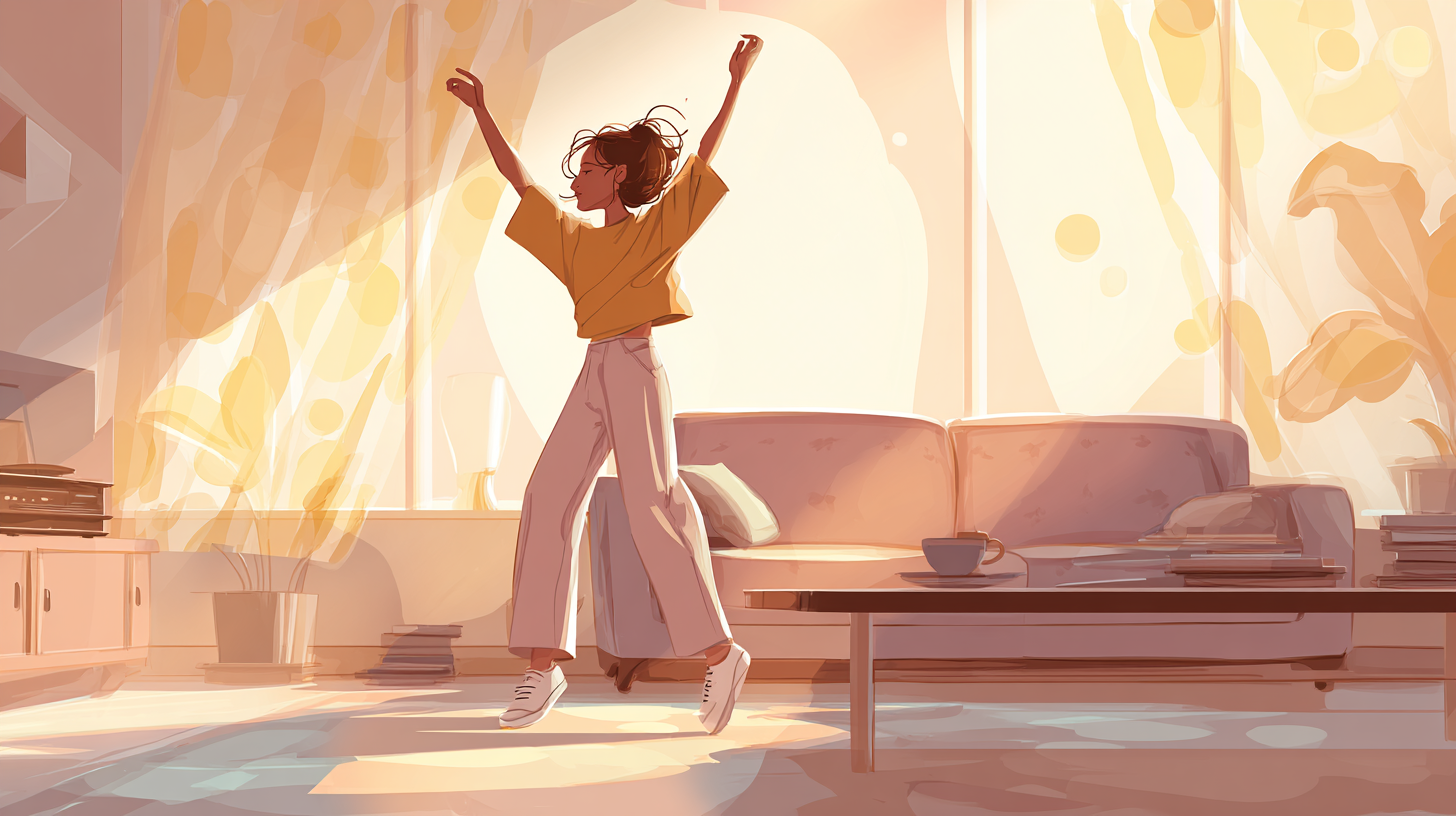
Do not imagine that all movement must be grave and solemn, performed only in somber garments and with the air of penitence. There is also dancing. Close the door, if you like, and put on some music that stirs you. It does not matter whether your steps are elegant. No one is judging the performance; there are no critical aunts in the gallery. Two or three songs — perhaps ten minutes of cheerful nonsense — will leave your heart beating in a livelier manner and your spirits less inclined to sulk. For those who struggle with gloom or unease, this small ball in the sitting room can be as helpful as many a more formal remedy.
Let us turn to housework, that old and often tiresome acquaintance. It may never be your favorite, but we may at least coax it into serving your fitness as well as your dust. When you sweep or vacuum, add a little intention: long strokes, firm steps, your posture tall. As you carry laundry, make two or three extra trips up and down the hallway, as if you were a very conscientious maid. When you fold clothes, stand rather than sit, and every few shirts, step to the side and back again, like a modest little dance among the socks. You are doing the work anyway; let it count twice, once for the tidiness of the house and once for the care of your body.
There are also small acts of strength you can tuck into odd moments. While you wait for something to heat in the oven, stand behind a chair and rise up on your toes, then lower yourself back down, as if you were curtsying to an invisible audience. Eight or ten of these, and your calves will complain in that agreeable manner that means they are learning to do more. When you brush your teeth, stand on one leg for several seconds, then switch to the other. You will wobble. That is the point. Your ankles and hips are practising their balance, like young ladies preparing not to stumble in the dance.
And what of stretching? Our poor modern bodies curl forward over screens and projects until our shoulders are almost acquainted with our ears. A few minutes, morning or night, can begin to reverse this conspiracy. Stand tall and gently roll your shoulders back, as if you were reminding yourself of your own dignity. Interlace your fingers and reach your arms overhead. Turn your head slowly from side to side, like a person surveying a ball and considering which partner to favor. No violent motions are required; only steady, kind ones. Your muscles, treated kindly each day, will be less likely to seize in protest when you ask a little more of them.
If you find these ideas agreeable in theory but difficult in practice, let us enlist the notion of “anchors.” Attach each small piece of physical activity to something you already do without fail. After you wake and before you dress, perhaps three minutes of gentle stretching. After each meal, five minutes of walking inside or outside the house. Before you settle onto the sofa at night, ten chair sit-to-stands. The habit rides upon the back of another habit, as a child rides upon a horse, and so the new behavior is carried along almost without your noticing.
You may protest: “But surely such little scraps of movement cannot matter.” Yet they do. The body knows nothing of grandeur; it only knows whether it has been asked to work, and how often. All these small acts — the stairs, the dancing, the sweeping, the stretches — add up like coins placed patiently in a jar. One day you look and find you possess a quiet strength you did not have before. The laundry basket feels lighter, the floor seems nearer when you stoop, the climb to the bedroom no longer resembles an Alpine expedition. In such modest triumphs, you will see that your home has been your ally all along, and that without ever stepping into a gym, you have been steadily, almost secretly, building a life in which your movement serves your days instead of burdening them.
Incorporating activity into your workday
Work has a way of chaining the body while it whips the mind. You sit in the glow of the screen. The hours roll past like empty freight cars in the night. Your back grows tight, your eyes burn, your thoughts tangle. Yet the day does not have to be like this. You can keep the job and still rescue your body. You can smuggle physical activity into the workday the way a man smuggles letters past a guard — quietly, steadily, until the prison no longer feels so strong.
First, you have to see the chair for what it is: not an enemy, but a trap that works too well. Long, unbroken sitting is tied to higher risks of heart disease, diabetes, and early death, even in people who exercise at other times [10]. The body was not meant to be folded in half for eight or nine hours. So the aim is simple and ruthless: no long stretches of stillness. Every 30 minutes, you stand, you move, you break the spell. Studies show that even two to five minutes of light walking or gentle movement every half hour can improve blood sugar and blood pressure across the day [11]. That is not a workout. That is a walk to the copier that lasts a little longer.
Set a quiet alarm on your phone or computer. Give it a name that feels like an order from a kind sergeant: “Stand now.” When it goes off, push your chair back. Stand up, even if only for sixty seconds. Reach your arms overhead. Roll your shoulders. Walk to the farthest bathroom instead of the nearest. Take the stairs down one flight and back up again. These small interruptions of sitting are like cracks in a dam; over time, the whole heavy wall of stillness begins to break.
If you have any say over your desk, put that say to use. A sit–stand desk, or even a cheap converter perched on top of an ordinary one, lets you raise your work to meet your spine instead of folding your spine to meet your work. Rotating between sitting and standing through the day can cut back pain and fatigue and improve comfort and productivity for many office workers [12]. You do not stand all day like a soldier on parade. Twenty to thirty minutes standing, then back to sitting, then up again — the body likes the change of state more than any single good posture held too long.
When you stand, stand like you mean it. Feet under hips, weight spread across the whole foot, not sagging on one hip like a bored actor. Soften your knees, pull your ribs away from your pelvis, let your head float above your shoulders instead of jutting out like a turtle. Now the simple act of answering emails becomes a mild strength exercise, almost respectable work for the legs and back. Your fitness rises in the background while your inbox complains in the foreground.
The phone is your ally if you let it be. Make a rule: you do not sit for calls. You walk. You pace the room, the hallway, the strip of carpet between two anonymous plants. If there is a quiet stairwell, claim it like a small territory. Walk up and down while you talk. For long calls that demand focus, small studies suggest that light walking can sharpen thinking for some people, not dull it [13]. The brain receives more blood, and the words come easier. If you must take notes, walk for half the call, then stand while you write.
Then there are the stealth exercises, the ones you can perform without drawing a committee meeting. When you wait for a file to load or a meeting to start, plant your feet and tighten your thighs, then release. Squeeze your glutes while you sit, count to five, let go. No one sees. Your muscles, neglected during long hours of desk work, remember their purpose. Under the table, lift your heels and tap your toes. At the printer, rise up onto your toes and lower yourself ten times. These are small rebellions, done in silence. The body understands.
Use the office itself as equipment. A sturdy desk or windowsill becomes a bar for incline push-ups: hands on the edge, feet back, body in a strong line, lower and push away. Ten of these in the privacy of a break room can leave your arms humming like a low song. A heavy box of paper is a makeshift weight; you can lift it from floor to hip, hip to shoulder, shoulder to overhead, moving slowly, keeping your back straight, using legs and core. These brief, sensible lifts done a few times a week can help maintain strength, which in turn supports your joints and eases everyday tasks [3],[8]. You are not body-building. You are refusing to rust.
Not every workplace has walls and doors. Some have open ceilings and watchful eyes. In those places, we trade big movements for smaller ones, but we do not surrender. Stay tall in your chair. Pull your shoulder blades gently back and down. Every hour, place your hands on your thighs and press down while you try to lift your legs, bracing your middle. Ten breaths, then rest. When you go to the restroom or the break room, add a lap around the floor. Walk with purpose, not slouching, not skulking. You are on patrol for your own health.
Meetings, those long, airless tunnels of talk, can also be bent to your will. When it is your meeting to run, offer a stand-up version. Short, focused, everyone on their feet. Research shows that standing meetings often run faster without losing effectiveness, and they chip away at total sitting time [14]. For one-on-ones, suggest walking if the space allows it — around the block, through the parking lot, even slow loops inside the building. Walking meetings have been linked with more creative thinking and higher engagement for some teams [13]. Talking shoulder to shoulder, instead of eye to eye over a desk, softens certain conversations. The legs move; the words move with them.
If your work is at home, the same rules hold, but the landscape shifts a little. You can put the printer at the far end of the room. You can carry your own tea instead of asking anyone else to bring it. Take five-minute “movement breaks” between tasks: march in place, climb your own stairs, step out to the sidewalk and back. The temptation at home is to blur work and life into one long gray smear of screen-time. Do not let that happen. Use movement as a line drawn in ink between tasks, a small ritual of ending and beginning.
For those whose work is not at a desk but on their feet — nurses, servers, teachers, workers on shop floors — the battle is different. You are not fighting stillness; you are fighting strain. The body is tired but not always strong in the right places. Here, the answer is not to pile more hours of hard labor onto an already beaten frame, but to add short, careful movements that protect it. Gentle stretches for calves and hamstrings in the break room. Slow shoulder rolls before a shift. A few squats holding onto a sturdy chair to keep hips and knees from stiffening. These are the small repairs that keep the machine running.
You may wonder whether such scattered, humble scraps of effort can really count as physical activity. The evidence says yes. The World Health Organization and other bodies now recognize that movement “snacks” — brief bursts of walking, climbing stairs, or other daily actions — help you meet weekly activity goals and improve markers of health when they accumulate over time [1],[10],[11]. Ten minutes here, five there, seven somewhere else: added together, they become the thirty or sixty minutes that studies say can lower risk of heart disease, stroke, diabetes, and early death [1],[2]. The body keeps its own quiet ledger and does not care whether the steps were taken on a treadmill or on worn office carpet.
To make this stick, you weave movement into the very structure of the workday instead of treating it like an extra errand. Park a little farther from the building. Take the stairs when you can. Drink water steadily so that you are forced to stand and walk to the restroom, then choose the one on the next floor. Put the trash can across the room so you must get up to use it. At lunch, protect ten minutes for walking before you return to your desk. None of this is majestic. All of it counts.
In time, these quiet acts of rebellion change you. The long afternoons no longer feel like a slow suffocation. Your back does not ache so fiercely by evening. Your mind is less blurred at four o’clock. You notice that you climb the office stairs without bargaining with yourself. You leave work tired but not broken. This is how it begins: not with a grand program or a heroic declaration, but with one person in an ordinary chair deciding, several times a day, to stand up and remember that the body is meant to move.
Active commuting and errand strategies

Now that your workday has learned to bend a little to your will, we may turn our attention to the world beyond your front door. The streets, the pavements, the buses, even the grocery store — all of them are secret accomplices waiting to be claimed. You may imagine, perhaps, that a proper exercise routine must be dressed in special clothes and performed in a solemn temple of treadmills. But, my dear, the road to better health often begins with something as modest as walking to the corner instead of driving to it.
Consider first the notion of travelling to your work or daily engagements under your own power, at least for part of the journey. If you live close enough, you might walk the whole way. I promise, the world looks quite different when observed at three miles an hour instead of thirty. The houses appear less severe; the trees reveal individual branches; even the morning air has more to say. A twenty-minute walk to and from your destination gives you, with charming simplicity, forty minutes of physical activity wrapped around duties you must perform anyway. It is exercise hidden in plain sight, like a generous inheritance tucked into the lining of an ordinary coat.
But what if your place of business lies far away, over highways and rail-lines and all manner of distance? We need not surrender. Instead, let us think in segments. Perhaps you drive part of the way, then leave your carriage — or, in our less romantic age, your car — a ten- or fifteen-minute walk from the office. Park in the farthest corner of the lot rather than jostling for the nearest space. Or alight from the bus or train a stop or two before your usual one and walk the rest. These modest adjustments lengthen your daily movement without demanding an extra hour torn from your evening. Over weeks and months, such habits whisper steadily into your fitness, building endurance as quietly as ivy climbs a wall.
If you own a bicycle and a reasonably safe path, you possess an even more delightful form of travel. Cycling to your errands or to work is like dancing with the wind: useful, and yet a little romantic. You must, of course, make certain that you are not flung into danger by reckless traffic — no amount of fitness is worth a broken limb. But in cities with bike lanes, or in quieter neighborhoods, a gentle ride of fifteen or twenty minutes can transform a dull commute into something almost pleasurable. Many who cycle to work report arriving more alert and in better spirits than when they drive, for the simple reason that the heart has been allowed to beat with purpose before the mind is dragged into its daily storms.
Suppose, however, that you cannot cycle and the distance is too great to walk in full. We may still employ a strategy I call “edge walking.” Wherever you go — to work, to the shops, to a friend’s — ask yourself: can I walk a little at the beginning and a little more at the end? Perhaps you park near a small park and cross it on foot, taking the long path rather than the direct one. Perhaps you choose the bus stop that requires a brisk five-minute walk rather than the one outside your very door. Each small edge you add around your necessary journeys builds a frame of movement around the picture of your day.
Errands, those tiresome but unavoidable chores, can also be twisted gently in your favor. Instead of hoarding them for a single, enormous excursion by car, consider grouping those that lie within a reasonable distance of one another and walking them in a little circuit. Take, for example, the post office, the pharmacy, and the green-grocer. If they are all within a mile, you might park once, if you must drive at all, and then accomplish the rest on foot. You carry a light bag, you walk between each shop, and by the time you have posted your letter, filled your prescription, and bought your fruit, you have also enjoyed twenty or thirty minutes of steady motion — all justified by productive tasks that no one can accuse of being frivolous.
There is something almost cunning about turning a grocery trip into a walk. If your market lies within reach, leave the car at home altogether. Take a reusable bag or a small rolling cart and walk there. Buy only what you can comfortably carry — this has the agreeable side effect of discouraging impulsive piles of biscuits. Returning with your modest bundle, you have not only stocked your pantry but also practised light strength training, for carrying a bag with good posture works the arms and back in a most honest, old-fashioned way. Do not overload yourself, of course; you are not a packhorse. Visit more often with smaller loads, and your body will benefit from the repeated trips.
Where distance makes walking impossible, we can still enliven our time in transit. If you ride a bus or train, stand when you can instead of sitting at every opportunity. Hold the rail lightly, allow your legs and middle to do the subtle work of balancing as the vehicle moves. This quiet engagement of muscles may appear trivial, but repeated day after day, it strengthens the small stabilizing muscles that keep you steady on stairs and curbs. When you must wait — for delayed trains, slow companions, or long queues — do not collapse into complete idleness. Shift your weight from one leg to the other, gently rise to your toes and lower again, roll your shoulders back, take a brief stroll up and down the platform instead of guarding a single patch of ground as if you had planted a flag upon it.
You may object that all this sounds very well in a charming village, but that your own streets are noisy, the air rather rude, the drivers impatient, and the sidewalks sometimes scarce. These are not trivial concerns. Safety is a first principle. In such circumstances, you might seek quieter routes: side streets rather than main roads, parks instead of car-choked avenues, even indoor corridors in large stores or public buildings when the weather or traffic becomes truly unfriendly. Many people have made a practice of walking laps in shopping centers before the stores open — a sort of modern promenade, with less scenery but also less rain.
To turn these strategies from pleasant ideas into firm habits, it helps to give them fixed occasions, just as we did with movement in the home. For instance, you might decree that every trip under half a mile shall be walked if it is at all safe to do so. Or you may appoint certain days as “car-light” days, when you arrange your errands so that most of them demand your legs rather than your engine. Perhaps, once a week, you choose one common destination — the library, a café, a friend’s lodgings — and always walk there if circumstances permit. The mind loves rules as much as it pretends to hate them; once it learns the pattern, it stops debating every little choice.
Think, too, of companionship. A solitary walk to the store may be pleasant; a shared one can be entirely more agreeable. Invite a neighbor to join you when you post a letter or fetch milk. Suggest to a colleague that you both walk from the train station together rather than stand in the taxi line. When movement is also conversation, the minutes slip away almost without notice, and your feet have done good work before your mind has had time to protest.
Those who must care for small children may feel that they are already moving at all hours, yet much of that movement becomes a frantic flurry from car to door and back again. Perhaps, instead, you can sometimes leave a few minutes early for school pick-up and park farther away, walking the final stretch with your young companions. Children, it is true, do not always walk in straight lines; they meander, they skip, they stop to examine every stone. But their natural restlessness is, in itself, excellent physical activity. By walking with them rather than driving them from point to point, you not only care for your own body but also teach them, by example, that legs are meant for more than pressing pedals.
Step by step, errand by small errand, the pattern of your days shifts. You begin to think, whenever a journey is proposed, “How much of this can I perform under my own power?” At first, the answer may be “very little.” But in time, as your stamina quietly grows, that answer changes. Half a mile becomes comfortable; a mile begins to feel quite within reach. You notice that hills which once appeared impertinently steep now seem merely interesting. The post office no longer feels far; the market becomes a pleasant walk rather than a chore.
And here lies the quiet triumph: you have not “gone to the gym” or embarked upon some punishing regime. You have simply trained your body to accompany you more faithfully through the practical business of living. Your commute, your shopping, your visits — all the small threads that weave a day — now carry within them a gentle, steady current of movement. In this way, your fitness stops being an item on a separate list and becomes part of the fabric of your life, as natural and unremarkable as tying your shoes before you step outside the door.
Staying motivated and tracking progress
Resolve alone will not carry you far; feeling and evidence must walk beside it. If movement is to become part of who you are rather than a project you chase and abandon, you must learn two arts: how to keep going when your mood falters, and how to see, with your own eyes, that your quiet work is changing you. Without these, even the best plans for physical activity dissolve into the ordinary fog of life.
Begin by stepping away from the language of punishment. “I must lose weight.” “I should exercise more.” These phrases sound like scoldings from some stern relative. Instead, ask yourself a gentler, yet sharper, question: “What kind of life do I want my body to let me live in five, ten, twenty years?” Do you wish to be able to walk a hill without gasping, to kneel down to play with a child and rise again without wincing, to carry your own bags, to travel without fear of every staircase? Let those images, concrete and vivid, become your private compass. Weight, appearance, and numbers may come and go; being able to live the life you imagine is a motive that ages well.
Once that image is clear, translate it into goals that are small enough to be real. “I will walk for ten minutes after dinner on four evenings this week.” “I will take the stairs one extra time per day.” “I will stretch for five minutes before bed on weekdays.” These are not acts of heroism; they are promises almost too modest to break. Research on behavior change shows that goals which are specific, measurable, and realistic are more likely to be kept than vague wishes like “get in shape” or “improve my fitness” [15]. Think of each clear promise as a stitch; over months, they sew a new pattern into your days.
Still, the mind has a way of slipping out of even the simplest commitments. This is where tracking becomes a quiet but powerful ally. When you keep a record, you are no longer relying on hazy memory; you are gathering evidence. Use whatever tool suits your temperament: a notebook by the door, a calendar with small marks, a spreadsheet, a phone app that counts steps or minutes. Each time you walk, climb, dance, or stretch, you add a mark. The page fills. The month grows speckled with proof. You are not guessing whether you are active; you are watching the story unfold in ink.
There is something oddly satisfying about seeing streaks of success. Five days in a row of walks. Three weeks with at least two strength sessions. The human brain loves patterns and hates to break them. This “don’t break the chain” effect has helped writers, musicians, and students build daily practice; it can help you build movement, too. Post a simple wall calendar where you will see it every day. For each day you keep your small promise to move, draw a symbol — a check, a star, a dot. After a few weeks, that string of marks becomes something you do not wish to interrupt lightly.
Yet life is not kind enough to always preserve your streaks. Travel, illness, crises, and sheer fatigue will sometimes break your run of good days. Expect this; do not treat it as a personal failure. When a gap appears on your calendar, resist the old story of “I’ve ruined it; what’s the point now?” Instead, adopt a single rule: never miss twice for the same reason if you can help it. If one day is lost to chaos, let the very next possible day be a return, no matter how small. This “two-day rule” turns relapse from a spiral into a stumble you quickly correct.
The numbers you track can be simple: minutes walked, steps taken, flights of stairs climbed, days per week you did something that made your heart work. Over time, if you like, you can add other measures: how many push-ups from the counter you can manage, how long you can balance on one leg without support, how far you can walk before you feel truly tired. These are functional signs of health, often more meaningful than any single reading on a scale. They ask not “What do you look like?” but “What can you do?” That is the question the future will care about.
When you track, resist the trap of perfectionism. There will be weeks when your chart looks sparse, when your step count falls, when your planned workouts fragment into a few untidy minutes. That is not the moment to abandon your records in shame; it is the moment to look with curiosity. What made this week difficult? Did work expand? Did sleep shrink? Did the weather or your mood drown your earlier enthusiasm? Instead of asking, “What is wrong with me?” ask, “What made this hard, and what might make it easier next time?” This shift from blame to investigation is the difference between quitting and adjusting.
You can make the act of tracking itself a ritual that nourishes you. In the evening, before you close the day, glance at your log and write one sentence about how you felt after moving. “Felt calmer after walk.” “Knees a bit sore; stretched and improved.” “Surprised how much better my mood was after ten minutes of dancing like a fool.” Over weeks, you will build not only a record of behavior but a record of benefits. When motivation fades — and it will — you can read your own words instead of generic advice. Your past self becomes your coach, reminding you that, for you, movement has been medicine.
External accountability can also wield a quiet power. Some people thrive with a walking partner, a weekly class, or a small group chat where each person posts their daily movement. Not everyone needs or enjoys company, but if you find that you repeatedly break promises to yourself, consider making at least some of those promises visible to another human being. Agree to text a friend when you finish your walk, or to send a screenshot of your weekly steps. The point is not to invite judgment, but to harness a simple truth: we are often more willing to disappoint ourselves than to let someone else down.
Rewards, used wisely, can help in the early weeks while the habit is fragile. Choose rewards that do not undo your efforts: a new book after two weeks of consistent walking, some pleasant music or a favorite podcast saved only for your movement time, a warm bath after a week of keeping your promise. Let the walk or stretch be paired with something you genuinely enjoy, so your brain comes to associate movement with pleasure rather than duty. Over time, as you begin to notice the internal rewards — better sleep, steadier mood, easier stairs — you may need the external trinkets less.
There will be days when your mind offers a hundred excuses. “Too tired.” “Too busy.” “I’ll start again Monday.” In those moments, shrink the task until it becomes almost laughably small. Instead of a thirty-minute walk, tell yourself: “I will walk for three minutes.” Instead of a full strength session, “I will do five chair sit-to-stands.” Often, once you begin, you will do more. But even if you stop at three minutes, you have kept the identity alive: “I am a person who moves every day.” Identities, once formed, are stubborn things. They begin to pull your behavior into alignment almost without your noticing.
Do not overlook the power of environment in sustaining motivation. Lay out your walking shoes where you will see them. Keep a resistance band or light dumbbell near the chair where you usually sit in the evening. Save a playlist or podcast precisely for your walks so that starting the movement is tied to starting something you want to hear. Each of these is a silent nudge, reducing the effort required to begin. The fewer decisions you must make in the moment, the more likely you are to follow through on your earlier, wiser intentions.
As your consistency grows, consider testing yourself gently from time to time. Not in a harsh, competitive way, but as a scientist might check an experiment. Once a month, walk the same route and see whether it feels easier or faster. Try holding a balance pose for as long as you can while timing yourself. Count how many times you can rise from a chair in thirty seconds. These modest tests turn the abstract idea of “better fitness” into something you can feel and measure. They invite you to see your own progress, not in other people’s bodies or social media boasts, but in the plain, humbling laboratory of your daily life.
Perhaps the most important part of staying motivated is to keep asking yourself why this matters, not once, but again and again as the years pass. Your reasons will change. What begins as a wish to look a bit trimmer may evolve into a desire to keep up with children, then grandchildren, to maintain independence, to continue a beloved hobby, to serve in your community, or simply to climb your own stairs unassisted. Let your motives mature; let them deepen. Each season of life offers a new answer to the question, “For the sake of what will I move today?” If you listen closely, you may find that this question reaches beyond health and fitness into the kind of person you are becoming.
In the end, tracking and motivation are not about chasing perfection but about building a gentle, stubborn relationship with your own body. You are learning to treat it not as a disobedient servant to be driven, nor as a fragile ornament to be protected from every effort, but as a companion in your work, your love, your worship, your service. When you jot down your steps, when you lace your shoes on a reluctant evening, when you choose to begin again after a lapse, you are making a quiet declaration: that your days are worth inhabiting fully, and that your body will not be left behind while your life hurries on ahead.
- How much physical activity do I really need each week?
- Most guidelines suggest at least 150 minutes of moderate activity or 75 minutes of vigorous activity per week, plus muscle-strengthening work on two or more days. You can break this into short sessions — even 5–10 minutes at a time — as long as it adds up across the week.
- Do short bursts of movement throughout the day actually improve my health?
- Yes. Research shows that “movement snacks” — brief bouts of walking, climbing stairs, or light exercise — help improve blood sugar, blood pressure, and overall fitness when they accumulate over the day. Your body adds them together, even if they never look like a formal workout.
- What if I hate traditional exercise like running or going to the gym?
- You do not need to love gyms to care for your body. Walking, dancing at home, active chores, gardening, and playing with children all count as meaningful physical activity. The key is to choose activities you can enjoy often enough to repeat.
- How can I stay motivated when I keep starting and stopping?
- Focus on very small, specific goals and track them where you can see them, such as a calendar or simple log. When you inevitably miss days, use it as information rather than proof of failure, and commit to your next tiny step instead of waiting for a “perfect” time to start over.
- Is it safe to increase my activity if I have health problems?
- Most people with chronic conditions can benefit from more movement, but the type and pace of increase matter. Talk with your healthcare provider about safe options, start slowly, and pay attention to warning signs like chest pain, severe shortness of breath, or dizziness.
- How do I know if I’m making progress without obsessing over the scale?
- Look for changes in how you feel and what you can do: easier stairs, less joint stiffness, better sleep, steadier mood, or walking farther before feeling tired. Simple tests like counting how many times you can rise from a chair in 30 seconds can show improvements in strength and function.
- What should I do on days when I feel too tired or busy to move?
- Shrink your plan instead of skipping it entirely: walk for three minutes, stretch for five, or do a handful of sit-to-stands. Keeping the habit alive, even in tiny form, protects your long-term progress and makes it easier to return to longer sessions when life settles.
Ashland Sabbath Chapel Ministries
Beside our live streamed church services, all are welcome to attend our church in person each Saturday beginning 10:00 AM Central Time by going to 2425 Owens Rd., Ashland, AL 36251. There is no cost and any donations are strictly voluntary.
For questions, call +2563547124.