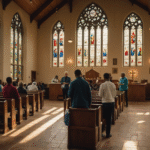
Come join Ashland Sabbath Chapel Ministries each Saturday for live streamed church services. Bible Study begins at 10:00 AM Central Time and Sermon at 11:00 AM. Visit Our YouTube channel and watch from home!
In the genteel days of the mid-nineteenth century, when the Adventist movement was but in its infancy, the notion of family education took root among the faithful followers. Ellen G. White, that most remarkable lady of profound spiritual insight, championed the cause of home-based instruction as early as 1872, believing it to be the most divine arrangement for young minds.
These early Adventist families, much like the heroines of our beloved novels, found themselves quite determined to preserve their children from what they perceived as worldly influences in common schools. They established their own particular method of education, combining bible study with practical subjects, a practice that would later influence the entire denomination’s educational philosophy.
During the 1960s and 1970s, when public education began to shift away from traditional values, numerous Adventist parents revived these historical practices. They drew inspiration from their pioneering ancestors, particularly the counsel found in White’s seminal work “Education” (1903), which emphasized the harmony of mental, physical, and spiritual development.
The movement gained considerable momentum in the latter part of the twentieth century, with families establishing networks of support across the country. These devoted parents, much like their predecessors, maintained detailed records of their educational endeavors, many of which survive in denominational archives today, providing us with a fascinating glimpse into their methodical approach to home instruction.
Religious motivation and beliefs
The fervent desire to raise children in accordance with Adventist principles stands as the cornerstone of their educational philosophy. These devoted families, much like those who gather for evening prayers in our finest country homes, hold fast to the belief that bible study must permeate every aspect of learning. As documented in the Review and Herald (1890-1915), parents consistently expressed their conviction that education extends far beyond mere academic pursuits.
The Adventist understanding of education encompasses both temporal and eternal considerations, with particular emphasis on character training. They maintain, with quiet determination, that their children’s minds are sacred vessels to be filled with divine truths alongside scholarly knowledge. This belief stems from their interpretation of biblical passages such as Deuteronomy 6:6-7, which commands parents to diligently teach their children throughout daily activities.
Central to their educational philosophy is the concept of preparing young souls for both earthly service and heavenly citizenship. The notion of the Great Controversy between good and evil shapes their curriculum choices, as parents seek to fortify their children’s faith against what they perceive as worldly philosophies that might challenge their beliefs. Research by Anderson (2018) suggests that Adventist homeschooling families place particular emphasis on developing critical thinking skills within a biblical framework.
These dedicated parents view themselves as stewards of their children’s spiritual and intellectual development, a responsibility they undertake with the utmost gravity. They believe, much like the apostle Paul’s instruction to Timothy, that all scripture is profitable for instruction, making family education an essential vehicle for transmitting both faith and knowledge to the next generation.
Their conviction extends to the belief that character development and academic excellence need not be mutually exclusive. Indeed, many Adventist families maintain detailed journals documenting how biblical principles enhance their children’s understanding of subjects ranging from natural sciences to literature, creating a harmonious blend of faith and scholarly pursuit.
Educational practices and curriculum
The curriculum employed by Adventist homeschooling families represents a carefully orchestrated symphony of spiritual instruction and academic rigor. The cornerstone of their educational approach integrates practical learning with traditional subjects, ensuring children develop both intellectual acumen and useful life skills. Mathematics, for instance, finds its application in household budgeting and carpentry, while science studies often incorporate gardening and natural remedies.
Their distinctive curriculum typically follows a morning-to-evening schedule, beginning with bible study and devotional exercises. The core subjects – reading, writing, and arithmetic – are taught through the lens of biblical principles, with carefully selected textbooks that align with Adventist values. Many families utilize materials from Adventist publishers, supplemented by secular resources that undergo thorough scrutiny for doctrinal compatibility.
Emphasis on skill development manifests through practical arts such as cooking, sewing, and basic mechanical repairs. These families, much like the industrious pioneers of old, consider such abilities essential for self-sufficiency and service to others. Their children learn to preserve food, maintain gardens, and master various handicrafts, skills that prove invaluable in both domestic and missionary endeavors.
The academic calendar often follows natural rhythms rather than conventional school terms, with families incorporating seasonal activities into their lessons. During harvest time, children might learn biology through food preservation, mathematics through crop calculations, and chemistry through bread baking. This integrated approach ensures that learning remains both practical and memorable.
Health education occupies a prominent position in their curriculum, reflecting the denomination’s emphasis on physical well-being. Students study nutrition, anatomy, and natural remedies, often maintaining their own health journals and conducting simple experiments in their home laboratories.
Languages, particularly Biblical Greek and Hebrew, frequently appear in advanced studies, enabling students to engage with scripture in its original tongues. Music education, focusing on hymns and sacred compositions, develops both artistic appreciation and worship skills. In many households, instrumental practice becomes a daily ritual, much like morning prayers.
Parental involvement and teaching methods
The dedicated involvement of Adventist parents in their children’s family education manifests through a carefully structured approach to daily instruction. These resourceful educators, wearing both the hat of parent and teacher, typically dedicate the prime morning hours to core subjects, when young minds are most receptive to learning. They maintain meticulous lesson plans, often rising before dawn to prepare the day’s activities, much like those diligent souls who tend to their morning chores with unwavering dedication.
Teaching methods emphasize hands-on engagement and practical learning, with parents incorporating real-world applications into every subject. Mathematics lessons might involve measuring ingredients for bread-making, while science experiments utilize common household items. These clever instructors understand that a child who discovers knowledge through experience holds onto it far better than one who merely memorizes facts from a book.
The art of individualized instruction stands as a cornerstone of their approach. Parents carefully observe each child’s learning style, adjusting their teaching methods accordingly. Some youngsters might grasp concepts through tactile experiences, while others learn better through auditory or visual means. This flexible approach, combined with skill development activities, ensures that each child progresses at their optimal pace.
Many Adventist parents employ the “morning basket” method, where families gather for shared learning experiences. This might include Bible readings, nature study, or historical narratives. They’ve developed creative assessment techniques that go beyond traditional testing, often using project-based demonstrations of learning and maintaining detailed portfolios of their children’s work.
Parents frequently collaborate with their children to establish daily and weekly goals, teaching time management and personal responsibility. They incorporate regular periods of physical activity, understanding the vital connection between bodily movement and mental acuity. Creative expression through art, music, and writing receives particular attention, with many families maintaining journals documenting their educational journey.
Community support and resources
Adventist homeschooling families benefit from a robust network of support systems and resources that enhance their family education journey. Local Adventist churches often serve as central hubs, providing meeting spaces for cooperative learning activities, curriculum sharing sessions, and educational workshops. These communities maintain lending libraries filled with approved textbooks, educational materials, and religious resources.
Many families participate in homeschool co-ops, where parents pool their expertise to teach specialized subjects. These gatherings facilitate practical learning through group activities such as science fairs, musical performances, and physical education programs. Regular field trips to nature centers, historical sites, and mission outposts provide enriching experiential learning opportunities.
Online platforms specifically designed for Adventist homeschoolers offer curriculum guidance, teaching resources, and virtual support groups. These digital communities enable families to share lesson plans, discuss educational strategies, and find solutions to common challenges. The Adventist Home Educator’s Association provides comprehensive support through newsletters, conferences, and professional development opportunities.
Regional homeschooling conventions bring together families, curriculum providers, and educational experts. These events feature workshops on teaching methods, curriculum selection, and legal compliance, while also offering opportunities to purchase educational materials and connect with other homeschooling families.
- How do Adventist homeschoolers maintain academic standards?
- They utilize standardized curriculum materials and often participate in achievement testing. Many families maintain detailed portfolios and follow structured assessment guidelines provided by Adventist educational organizations.
- What resources are available for teaching advanced subjects?
- Families have access to online courses, tutoring services, and cooperative learning arrangements. Many local churches provide specialized instruction in advanced mathematics, sciences, and languages.
- How do families handle socialization needs?
- Through regular participation in church activities, homeschool co-ops, and community service projects. Children often engage in sports programs, music ensembles, and youth groups.
- What support exists for new homeschooling families?
- Mentoring programs pair experienced homeschoolers with newcomers. Local support groups offer orientation sessions and ongoing guidance throughout the homeschooling journey.
- How do families access curriculum materials?
- Through Adventist publishing houses, curriculum fairs, and online marketplaces. Many communities maintain curriculum lending libraries and resource-sharing networks.
- What legal support is available?
- Homeschool legal defense organizations provide guidance on compliance with state regulations. Local support groups often include members knowledgeable about homeschooling laws.
- How do families fund their homeschooling expenses?
- Through careful budgeting, curriculum sharing, and cooperative purchasing programs. Some churches offer financial assistance and scholarship programs for homeschooling families.
Beside our live streamed church services, all are welcome to attend our church in person each Saturday beginning 10:00 AM Central Time by going to 2425 Owens Rd., Ashland, AL 36251. There is no cost and any donations are strictly voluntary.
For questions, call +2563547124.