Come join Ashland Sabbath Chapel Ministries each Saturday for live streamed church services. Bible Study begins at 10:00 AM Central Time and Sermon at 11:00 AM. Visit Our YouTube channel and watch from home!
When you want to change your body, you must first understand how you are living now. Think of it as taking honest inventory before you begin any new fitness plan. Set aside a quiet moment, free from distraction, and look at your days as they really are—not as you wish they were. This kind of calm, prayerful reflection has helped many people see where their time and strength are being used, and where they are being lost.
Begin by tracing a typical day from the moment you wake up until you lie down at night. Write it out if you can. Note what time you rise, how long you sit for meals, how you travel to work, how much time you spend in front of a screen, and what happens in the evening hours. You may find that long periods are spent in inactivity, even though you feel busy. Modern research confirms what our own bodies tell us: long, unbroken sitting is closely linked with higher risk of chronic disease and premature death, even in people who exercise at other times of the day (Katzmarzyk et al., 2019; Ekelund et al., 2016).
Next, pay attention to the signals your body has been sending. Do you feel stiff when you rise from a chair? Do you become breathless with a short flight of stairs? Does your back ache at the close of the day? These quiet warnings are not to be ignored. Many neglect such early signs until they grow into heavier burdens. The scientific literature supports what experience shows: low levels of daily movement are associated with increased risk of heart disease, type 2 diabetes, and even some cancers (Physical Activity Guidelines Advisory Committee, 2018). To care for your body is to preserve the instrument through which you think, work, and serve.
It is also wise to consider the seasons of your life. Are you working long shifts, raising small children, or caring for an aging parent? Your circumstances shape your opportunities for movement. Instead of lamenting what you cannot do, look carefully for what you can. A nurse may be on her feet for many hours, yet still need planned strengthening exercises. An office worker may have to sit much of the day, but can find ways to rise, stretch, and walk at regular intervals. When the apostle wrote that we should act as faithful stewards of all that has been entrusted to us (1 Corinthians 4:2), that charge surely includes the care of our physical powers.
Another part of assessing your lifestyle is to look at your energy across the day. When do you feel most alert? When do you feel dull and weary? Often, the times we are most tempted to collapse into a chair are the very times when a brief walk or some gentle stretching would restore us. Studies show that even short 5–10 minute bouts of light to moderate movement can improve mood and reduce feelings of fatigue (Puett et al., 2014). Notice the patterns: perhaps your energy drops in the afternoon, or you feel sluggish late in the evening. These observations will later guide you in choosing the best moments to build a new routine.
Take a sincere look at your present habits of sleep, eating, and stress as well, because they are woven together with movement. When sleep is neglected, people are less likely to be active and more likely to choose poor foods; both of these weaken the body and cloud the mind (Taheri, 2006). Too much caffeine, heavy late-night meals, and constant worry all drain vitality. A life of true temperance—avoiding what harms and wisely using what blesses—creates a foundation upon which daily activity can be safely and steadily increased.
Finance also reveals much about lifestyle. Examine where your money goes in relation to your health. Is it directed toward nourishing food and helpful tools, or spent mostly on conveniences that encourage inactivity, such as frequent takeout meals and delivery for tasks you might physically manage yourself? Our purchases often testify to the path we are walking long before our words do. Reordering how we spend can be part of the preparation for a more active life.
As you review these different parts of your day—time use, bodily signals, circumstances, energy, and habits—try not to excuse or condemn yourself. Instead, observe with the calmness of one who seeks light. Truthful awareness brings freedom. Once you can see clearly how you now live, it becomes far easier to decide what to change, and in what order. This thoughtful examination of your current way of living will become the firm ground upon which your new patterns of movement can be thoughtfully and prayerfully built.
Designing realistic fitness goals

Now that you have looked honestly at how you are living, the next step is to choose where you are going. Many people fail in their fitness efforts not because they lack desire, but because they set goals that are vague, rushed, or borrowed from someone else’s life. A confused aim leads to a confused walk. You would not set out on a journey without knowing at least the direction you intend to travel. So it is with your body. You need clear, humble, well-measured purposes that fit the strength you now have and the path you are on.
Begin by asking, “What do I truly want my body to be able to do, and why?” Perhaps you long to climb a flight of stairs without gasping, to play on the floor with a child or grandchild, to complete a day’s work without nagging back pain, or to serve in your community with greater vigor. These are goals of real value, for they are linked with usefulness and service, not mere appearance. When the heart is set on honoring God in body and mind, and on blessing others with a stronger, more cheerful presence, then there is power to persevere when feelings waver.
It is helpful to turn these desires into simple, written statements. Instead of saying, “I should exercise more,” you might write, “In three months, I want to walk briskly for 30 minutes without stopping and feel less winded when I climb stairs.” Notice how this speaks of a specific action, a clear measure, and a time frame. Modern health educators often use the idea of making goals specific, measurable, attainable, relevant, and time-bound. You need not remember the letters, but do remember the spirit: make your intentions plain enough that you will know, beyond doubt, whether you are walking in them or not.
Yet in all this planning, beware of haste. One of the enemy’s subtle temptations is to urge people to attempt in a day what should be spread over weeks and months. A person who has long neglected movement may suddenly decide to run many miles, or to take on strenuous routines they have seen others do, and soon they are discouraged, sore, or even injured. God leads His children step by step. So, too, should you lead your body. Respect its current condition. Honor the years and burdens it has already carried. A gentle beginning, steadily built upon, will bring you further than a furious start followed by long retreat.
Think, for example, of a friend who has been mostly seated at work and home for many years. If she decides she will immediately walk five miles every day, she may succeed once or twice, only to be overcome with pain and fatigue. But if she resolves instead to walk ten minutes a day for the first week, then fifteen the next, then twenty, her feet, joints, and breathing will gradually adapt. In three months, she may be walking comfortably for half an hour or more. The slower path proves in the end to be the swifter, because it is the one she can continue.
When you design your goals, consider the different kinds of movement your body needs. Most people benefit from three types: activities that raise the heart rate and breathing; movements that strengthen muscles and bones; and gentle stretching that maintains flexibility. You do not need to join a gym to care for these needs. Brisk walking, climbing stairs, squats from a chair, lifting simple weights or even heavy books, and stretching before bed can form a balanced routine. You might set a goal such as, “I will walk briskly three days a week, perform a small set of strengthening exercises two days a week, and stretch for five minutes before sleep on most nights.” This is not grand in the eyes of the world, yet it is steady and wise, and over time it can greatly improve health.
Be sure your aims fit your present season of life, rather than some imagined season that has not yet arrived. A mother with small children, rising at night to care for them, may not be able to follow the same schedule as a student with free afternoons. A man working early morning shifts may find evening walks more suitable than dawn jogs. Instead of forcing yourself into another person’s mold, prayerfully look at your own days and ask, “Where can movement live peacefully here?” A goal that fights constantly against your daily responsibilities will soon be cast off; one that harmonizes with them can be gently woven into the fabric of your life.
It is also wise to set both “floor” goals and “ceiling” goals. The floor is the least you plan to do on a hard day; the ceiling is what you may do on a strong one. For instance, you might say, “On difficult days, I will at least walk five minutes after dinner. On better days, I will walk twenty.” This protects you from the all-or-nothing thinking that so often defeats beginners. Even on weary days, you preserve the habit, though in a smaller form. In this way, every day becomes a day of victory, not because you did all you wished, but because you did not give up entirely.
Another help is to break a larger aim into smaller milestones. If you hope to walk 150 minutes a week, as many national guidelines recommend for basic heart health, do not fix your mind only on the whole sum. Look first to ten minutes at a time. Rejoice when you notice that you no longer feel as tired at the end of that short walk. Then see whether you can add five minutes more. Each small increase is an answer to the effort you have made; it is evidence that the body, wonderfully made, is responding to the care you are giving it.
Remember too that numbers on a scale are a poor master. If weight loss is one of your desires, be careful not to make the scale the only witness to your progress. Instead, set goals that include how you feel and what you can do: sleeping more soundly, breathing more easily, standing from a chair without pushing with your hands, or carrying groceries without strain. These changes often appear before the body’s weight changes, and they are precious signs that your new fitness habits are bearing fruit. If you watch only the scale, you may overlook the quieter gains that matter just as much.
It is also needful, before increasing your activity, to consider your present state of health. Those with heart conditions, joint disease, or other chronic illnesses should consult with a competent health professional. This is not a call to fear, but to prudence. In the same way that you would seek counsel before making an important change in your work or your home, so should you seek sound advice when you plan large changes in the use of your body. A brief conversation with a trustworthy practitioner can help you shape goals that are both stretching and safe.
Once you have set your goals, write them in a place where your eyes will often rest upon them—on a card by your bed, near your desk, or on the refrigerator door. Keep them few and clear, not a long list that overwhelms the mind. You might choose one main goal for the next three months and one or two smaller supporting goals. Return to them in quiet moments and ask yourself whether they still fit your present circumstances. It is no failure to adjust a goal when life changes; it is wisdom. What matters most is not that you keep every detail of your first plan, but that you remain faithful to the purpose of caring for the body entrusted to you.
If you stumble—and you surely will at times—do not cast away your aims as though they were unworthy. A missed walk, a week of illness, a season of extra work or family concern can interrupt the best-designed plan. Yet the path does not vanish because you step off it for a time. As soon as you are able, return to the simple practices you chose, even if you must reduce them for a while. The same steady Hand that guides the stars in their courses is willing to help you bring order and strength into your daily routine. Lay your plans at His feet, seek wisdom for each day, and then act with the courage that comes from knowing your efforts are not merely for yourself, but for all whom your life touches.
Integrating movement into work and commute
When you think of exercise, you may picture a special time set apart—a gym session, a long walk, an exercise class. Yet much of your life is spent in the places between: at your desk, in your car, on the bus, walking from one building to another. These hours are often treated as empty spaces, but they are not empty at all. They are powerful opportunities, waiting quietly, in which you can build strength and guard your health. If we are faithful in these small intervals, the whole day takes on a different character, and movement becomes a natural part of your routine, not an extra burden added on top of life.
Consider the hours spent at work. Many sit long at a desk, scarcely rising except for a hurried trip to the restroom or a brief visit to the break room. This long, unbroken sitting presses upon the circulation, stiffens the joints, weakens the muscles, and clouds the mind. You may have felt it yourself: the dull heaviness after several hours in a chair, the fogginess that creeps over the thoughts. God did not design the body to be held motionless like a machine turned off. The body is meant for circulation, for the freshening power of movement. To restore this, you need not abandon your duties. Instead, you can weave small, frequent movements into them.
One simple practice is to stand and move for a few minutes every half hour, or at least every hour. You might set a quiet reminder on your phone or computer. When it sounds, push back your chair, stand tall, and let your shoulders roll gently. Stretch your arms overhead, turn your head slowly from side to side, and walk a short distance—perhaps down the hall or around your office. These brief interruptions will not hinder your work; many find they actually think more clearly afterward. The blood moves more freely, more oxygen reaches the brain, and tired eyes are given rest.
If your work allows, consider a standing desk or a desk that can be raised and lowered. Alternating between sitting and standing brings relief to the back and encourages gentle shifting and stretching. Those who cannot obtain such a desk are not without help. You can place your laptop on a stable, higher surface for part of the day, or hold meetings while standing when the situation permits. If talking on the phone is part of your work, try standing or walking during at least some of those calls. The aim is not constant motion without rest, but a rhythm of varied positions, so that no part of the body is held in one posture until it complains.
Think also of the pathways within your workplace. Many habitually seek the closest parking spot, the nearest restroom, the elevator instead of the stairs. Each of these choices seems small, but together they shape your days. Why not, when possible, choose the farther parking place and the restroom on another floor? Why not take the stairs for one or two flights, even if you ride the elevator the rest of the way? These extra steps, repeated day after day, can add many minutes of gentle cardiovascular movement without demanding any special equipment or extra trip to a gym. They also remind your heart and lungs of their duty, keeping them from the deep weakening that comes from constant ease.
Suppose a person must sit at a computer for many hours. Even here, small changes bring blessing. You might keep a full water bottle at your desk and decide to rise whenever you take a drink, walking a few paces as you do so. You could perform simple chair exercises: straightening one leg at a time and holding it for several seconds, tightening the muscles of the abdomen, or lifting the heels up and down to engage the calves. While these will not replace more vigorous activity, they stir the circulation and prevent complete stagnation. In this way you acknowledge that your body is present with you while you work; you do not treat it as though it were merely a hanger for your clothing.
The commute to and from work is another often-wasted resource. Many feel they are at the mercy of traffic, schedules, and delays, yet even within these boundaries there is room for choice. If you live close enough, could you walk or cycle, at least on some days? Even if the distance is too great for the entire trip, perhaps you can park farther from your building and walk the remaining way. Those who ride public transportation might choose to get off one stop earlier and walk the last few blocks, when it is safe and reasonable to do so. Such changes may add only a few minutes to your journey, yet they teach the body a precious habit: to move as part of getting where you need to go.
For those who must drive the whole distance, there is still much that can be done. Instead of circling the lot in search of the closest space, accept a spot farther away and take the walk as a gift. When you reach your destination a few minutes early, resist the pull to scroll idly through your phone. Step out of the car, walk around the building, stretch your arms and back. Even two or three minutes of fresh air can lift the spirit and prepare you to meet the duties of the day with a clearer mind.
Some commute long distances by train or bus. Here, you may not always be able to stand or move freely, but you can seek opportunities when they arise. If there is room, stand for part of the journey, keeping your knees soft and your weight shifting gently from foot to foot. You can tighten and release the muscles of your legs and abdomen, roll your shoulders, and gently twist your torso to relieve stiffness. When seated, sit tall, with feet flat on the floor, drawing your shoulders back and your chest open. This upright posture allows easier breathing and helps guard against the rounded back and forward head that so often lead to pain.
There are those who feel that such small efforts are scarcely worth their attention. They think, “Unless I can engage in a full hour of exercise, what is the use of these few minutes?” Yet this is not wise thinking. The body responds to every kindness. Modern research has shown that even short bouts of light to moderate movement scattered through the day can improve blood sugar control, reduce stiffness, and support heart health. More than that, these moments train your will. Each time you choose to stand instead of remain slumped, to walk a little farther, to take the stairs, you strengthen the part of you that chooses what is right over what is merely easy.
In making these changes, planning helps. Look at your daily schedule and ask, “Where, in my work and commute, can I place movement without neglecting my duties?” Perhaps you decide that at the beginning of every hour you will stand and stretch; that you will always take the stairs up two flights; that you will park in the same, more distant area of the lot; that during your lunch break you will spend ten of the minutes walking outside or in a hallway. Write these intentions down as specifically as you did your larger fitness goals. Treat them as appointments, not as afterthoughts to be kept only if you feel like it.
You may encounter resistance—from your own mind, from coworkers who do not understand, or from the habits of your workplace. Some may joke when they see you walking the stairwell or standing during a phone call. Let not such light things turn you aside. When your purpose is to preserve the strength God has given you, you need not be ashamed. Often, in time, those same coworkers will quietly ask how you began, and some may join you. In this way, one person’s faithful example can bring a spirit of healthfulness into an entire office.
There will also be days when interruptions, sickness, or heavy responsibilities crowd your plans. On such days, do not cast away the whole pattern because you cannot perform it perfectly. If you cannot take all your usual walking breaks, take one. If you are too weary for the stairs, at least stand and stretch more often at your desk. The habit of seeking movement, even in small ways, protects you from slipping back into total inactivity. You are not measured by one day, but by the direction in which your days, taken together, are moving.
As movement becomes part of your work and commute, you may notice subtle changes. Tasks that once left you drained are handled with a calmer spirit. Long meetings become more bearable when broken by quiet stretches. The drive home seems less wearing when you begin it with a brief walk to your car. You find that your back aches less at night, that your mind feels less foggy in the afternoon. These are tokens that the laws of the body, appointed for your blessing, are working in your favor as you cooperate with them.
Above all, remember that your body is more than a tool for earning wages or reaching destinations. It is an instrument through which you think, feel, and serve. When you bring movement into your workday and your travels, you are not merely “burning calories.” You are preserving the temple of the Holy Spirit, strengthening your capacity to be useful and cheerful, and honoring the One who fashioned you with such wisdom. Each step taken in a hallway, each stretch beside your desk, each choice of stairs over elevator becomes, in this light, a small act of stewardship. Day by day, these humble acts gather into a life in which health and duty walk hand in hand, and even the ordinary paths of work and commute become part of a living, breathing ministry of care.
Transforming household tasks into workouts
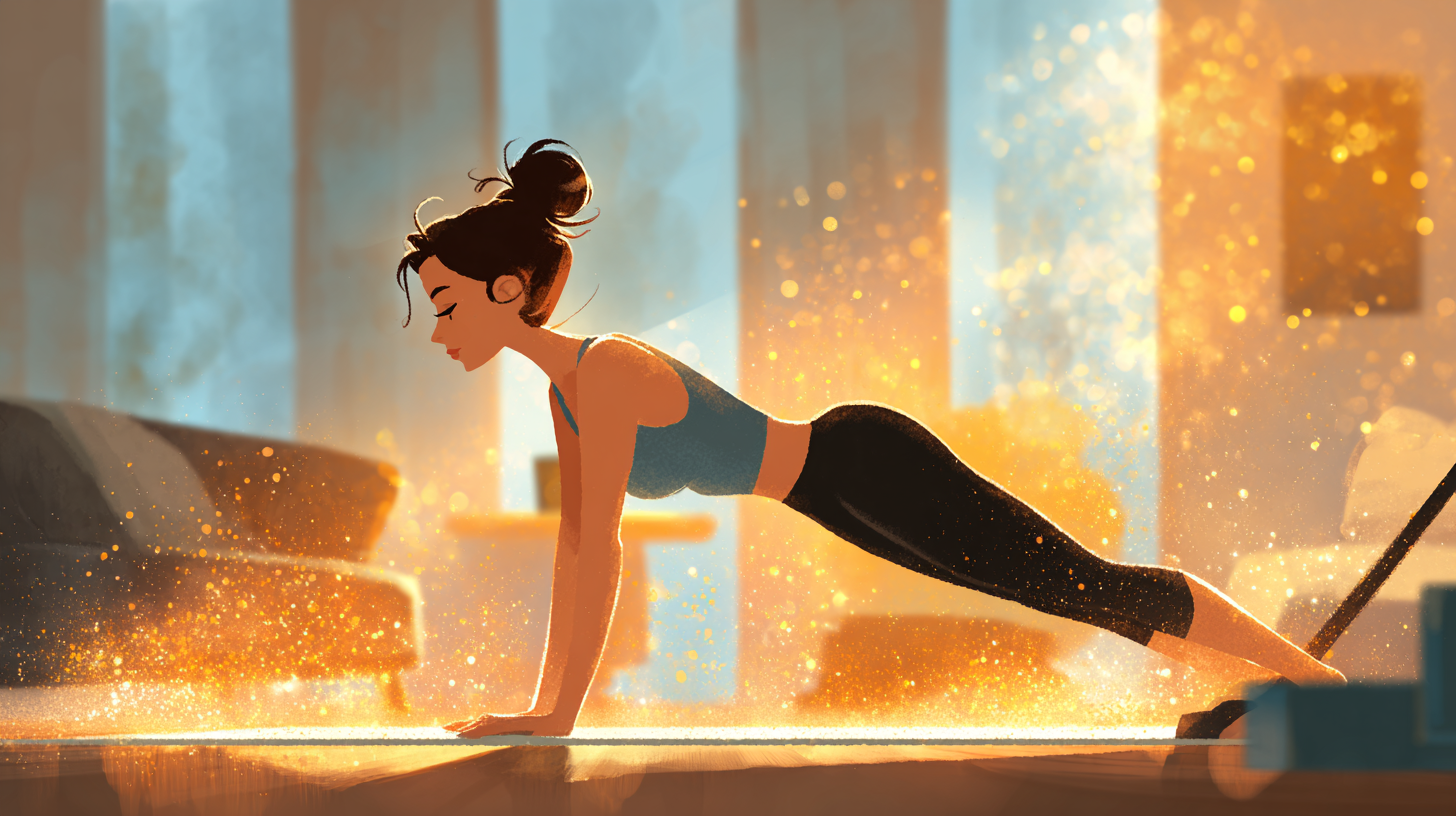
Now let’s walk into the room where most of life actually happens: home. People often say, “I’d exercise if I had more time, but after work and taking care of the house there’s nothing left.” Yet that is the very doorway through which your fitness can quietly enter. The research is clear that all movement counts toward better health, not only what you do in sports clothes under bright lights (World Health Organization, 2020). If that is true—and it is—then your sweeping, lifting, scrubbing, and carrying are no longer chores alone. They are raw material, ready to be shaped into a simple, steady routine that strengthens your body while you care for your home.
Begin with how you think about these tasks. Most people move through them half-asleep, just “getting them done.” Instead, look at them as chances to practice good posture, to work a little harder for short bursts, to engage muscles you usually ignore. Scientists call this “incidental” or “lifestyle” physical activity, and it’s linked with lower risk of heart disease and early death even when people do not perform formal exercise sessions (Saint-Maurice et al., 2018). You don’t have to change what you do at home as much as how you do it.
Take sweeping and vacuuming. Many bend from the back, shoulders slumped, dragging the tool around. Try this instead: stand with your feet about hip-width apart, knees softly bent. Keep your back long and your chest lifted. As you push and pull the vacuum or broom, let the movement start from your legs and hips, not from your lower back. Step forward and back in a lunge rather than twisting and reaching from a fixed position. A few minutes of this kind of focused sweeping will warm your legs, arms, and core far more than slouching and shuffling about.
You can turn this into a simple circuit. Choose one room. Sweep or vacuum it with purpose for five minutes, then pause to do ten slow squats, sitting back as if into a chair and rising with control, keeping your knees over your feet. Then return to the next section of floor. Repeat this pattern—task, brief exercise, task—until the room is finished. These little “bursts” of muscular work are much like interval training, which has been shown to improve cardiovascular fitness even when the total time is modest (Gibala et al., 2012).
Now think of laundry. We usually toss clothes in and out of baskets without a thought. Instead, make those baskets serve you. Place the basket on the floor and use a squat each time you pick up a bundle—feet planted, back straight, bending at the hips and knees instead of curling the spine. Carry the basket close to your body, using both arms to share the load. When you move from one room to another, walk briskly rather than shuffling. If stairs are part of your home, climbing them with a moderate load becomes built-in strength and cardio work. Carrying loads up stairs “counts” toward the kind of vigorous effort guidelines speak about; short, repeated bouts still improve heart and lung function over time (Piercy et al., 2018).
As you fold clothes, stand instead of sitting when you can. Place the basket on a higher surface to avoid constant bending from the waist. Every few minutes, pause and roll your shoulders, stretch your arms up overhead, and gently twist side to side. These small stretches ease the tension that often builds during tasks done in one position and help maintain flexibility, which declines steadily with age unless it is used (Nolan & Thomas, 2015). You will be surprised how much more refreshed you feel at the end of the chore.
The kitchen offers a whole gym’s worth of opportunity. While water boils or the oven preheats, those few minutes can be either thrown away in idle scrolling, or invested in strength. Try standing at the counter and doing countertop push-ups: place your hands on the edge, step your feet back, keep your body in a straight line from ankles to shoulders, and bend your elbows to lower your chest toward the counter, then press away. Start with five to eight repetitions and add more as you grow stronger. These work your chest, shoulders, and arms gently, using a resistance that your body knows well—its own weight.
Waiting for something in the microwave? Do calf raises: stand tall, rise up onto the balls of your feet, pause, then slowly lower. Aim for ten to fifteen repetitions. This simple move strengthens the calves, supports the ankles, and aids circulation in the lower legs, which is particularly important if you sit much of the day. Research shows that frequent, light muscular contractions in the lower limbs help keep blood from pooling and improve overall vascular function (Green et al., 2017).
There is also the quiet but powerful work of dishes and countertops. Many lean with their weight dumped into one hip, shoulders drooping toward the sink. Instead, stand with feet firmly planted, one foot slightly ahead of the other for balance. Draw your abdomen gently in, as though buttoning a snug coat. Let your shoulders rest down and back. As you scrub, resist the urge to hunch forward; think of lengthening upward from the crown of your head. Maintaining this kind of posture does not look like exercise, but it trains the stabilizing muscles of your trunk, which are essential for preventing back pain and for safe lifting (Hodges & Tucker, 2011).
Heavy household work—such as moving furniture to clean behind it, raking leaves, shoveling snow, or deep scrubbing—demands more energy and builds more strength. The American College of Sports Medicine notes that these kinds of activities can meet or exceed moderate-intensity exercise, depending on how vigorously they are done (Riebe et al., 2018). But they must be approached with wisdom. Before starting a heavy task, warm up. Walk briskly through the house for three to five minutes, swing your arms gently, and make some easy circles with your shoulders and hips. This brings warmth to the muscles and lubrication to the joints, reducing the chance of strain.
When you lift or move objects, let your strongest muscles carry the burden. Keep whatever you lift close to your body; the farther away it is, the more strain falls on your back. Bend at your hips and knees, keeping your back flat, and push through your legs to rise. Avoid twisting while holding a load; instead, turn your whole body by stepping. These are the same principles a wise trainer would teach in a gym. Here, they simply appear in work clothes instead of athletic wear.
Cleaning windows, high shelves, or walls above shoulder height can also be reshaped into safe, strengthening movement. Rather than overreaching from one spot, move your feet and bring yourself closer to the area you are cleaning. Use a stable step stool if needed instead of stretching from the floor with your arm at an awkward angle. As you reach overhead, gently engage your abdominal muscles and keep your ribcage stacked over your pelvis. This helps protect the lower back and encourages better shoulder mechanics, decreasing the chances of shoulder impingement that so often comes from repeated overhead work (Ludewig & Reynolds, 2009).
Outdoor chores form their own kind of training plan. Raking leaves or sweeping large areas can be treated as rhythmic, full-body work. Grip the handle with both hands, one higher and one lower, and alternate which hand is on top every few minutes so that both sides of your body share the effort. Plant your feet wide for stability, bend your knees slightly, and let your torso rotate smoothly with each stroke rather than jerking from the arms alone. This kind of rotational movement, done with control, can help maintain mobility through the spine and hips.
Gardening is equally rich in hidden exercise. You squat to pull weeds, hinge at the hips to plant, carry soil or watering cans. To make this safer and more beneficial, vary your positions. Use a kneeling pad and come down on one or both knees for a time, then shift to a half-kneeling position with one foot forward, then to a squat, then to standing. By rotating through these, you avoid exhausting any one set of joints while still giving your legs and hips significant practice in supporting and moving your weight. Long-term gardening has been associated with better balance and lower risk of falls in older adults, likely because it demands coordination, strength, and flexibility all at once (Park et al., 2014).
For many, the obstacle is not the lack of tasks but the lack of plan. Here is one way to bring order to it. Choose a particular window of the day—perhaps 20–30 minutes in the evening or on a weekend morning—that is already dedicated to housework. Before you begin, decide which chores must be done and which “bonus” movements you will pair with them. It might look like this:
- Five minutes of brisk tidying from room to room, walking quickly and standing tall.
- Ten minutes of focused sweeping or vacuuming, adding a set of ten squats every time you finish a room.
- Five minutes of countertop push-ups and calf raises while working in the kitchen.
- Five minutes of gentle stretching after putting away laundry—reaching overhead, bending side to side, and rolling shoulders.
This is only an example; you can shape your own. What matters is the deliberate pairing of chores with movements that raise your heart rate a little, challenge your muscles, and stretch tight areas. Over a week, these short additions may accumulate to more than the 150 minutes of moderate activity and two days of muscle-strengthening work recommended by national guidelines (Piercy et al., 2018), and you will have a cleaner home to show for it as well.
Do not overlook the quieter, child-filled, or caregiving parts of home life. Lifting a toddler, pushing a stroller up a hill, playing on the floor, or helping an older person move safely can all be harnessed as purposeful movement. When picking up a child, squat and draw them close before lifting, using your legs rather than your lower back. When you are on the floor, come up and down using different patterns—sometimes through a lunge, sometimes through a squat—to keep your hips and knees accustomed to varied work. These motions resemble the “functional” exercises used in rehabilitation to restore independence in daily life (Nelson et al., 2007).
If you share your home with others, invite them into this changed way of working. You might put on uplifting music and agree that, for the length of two or three songs, everyone will clean and move with energy—quick steps, tall posture, intentional lifting and bending. This not only turns housework into a sort of family fitness class, but strengthens the sense of shared duty and joy. Children, in particular, learn from what they see. When they watch you treat daily tasks as chances to care for your body rather than as purely burdensome obligations, they are more likely to grow into adults who see movement as a normal part of life, not a strange add-on.
You may wonder whether such home-based activity “really counts.” The evidence says yes. A large study following adults for several years found that people who accumulated their movement in short bursts throughout the day—such as through chores and walking—had similar reductions in mortality risk as those whose activity came in longer, planned sessions (Glazer et al., 2013). Another analysis showed that replacing 30 minutes of sitting with light household or walking activity was associated with lower risk of death, especially in those who were most inactive to begin with (Dohrn et al., 2018). In plain language, the way you sweep your floor and carry your laundry basket can help determine how long and how well you live.
At first, you may feel awkward paying so much attention to simple tasks. Your legs may ache a bit more after a session of “intentional cleaning” than they used to after casual, half-hearted sweeping. This is normal when long-neglected muscles are called again to service. Start small: perhaps pick one daily task and one weekly task to transform this week, and leave the others as they are for now. As your strength and confidence grow, you can bring the same care and purpose to more parts of your home life. In time, you will hardly remember what it was like to move through your house half-asleep. The very chores that once felt like thieves of your time will be revealed as quiet allies, helping you keep the body God has given you in working order for the duties and joys that await you each day.
Maintaining motivation and tracking progress
When the first excitement of a new fitness plan fades, what remains is the quiet work of faithfulness. Motivation, by its nature, rises and falls like the weather; if you build your routine on feelings alone, you will stop every time the sky clouds over. Instead, think in terms of covenant rather than mood: “These are the actions I have chosen before God and in sound reason; I will walk in them whether I feel eager or dull today.” This way of thinking moves you from chasing motivation to cultivating character, and character endures long after a passing burst of enthusiasm has vanished.
One of the simplest ways to support that character is to remove as many decisions as possible. Every extra choice—“Should I move now or later? This or that? Today or tomorrow?”—drains willpower. Decide once where your daily movement fits: perhaps a brief walk after breakfast, a strengthening session on two named evenings, a stretch before bed. Write it down, and treat these times as you would any serious appointment. When the hour comes, you do not debate; you simply step into what was already settled, much as you would show up for work or worship without a fresh internal argument each time.
Because human hearts are easily drawn away, external reminders can be a quiet mercy. A simple calendar on the wall, marked with a small symbol each time you complete your planned movement, turns invisible days into a visible record. Some people draw chains of X’s, others use colored stickers. The form does not matter; what matters is that you can see, at a glance, a story of faithfulness taking shape. When you notice a gap, you are invited not to shame, but to decision: “Will I let this break stretch on, or will I pick up the thread again today?”
You might also keep a small movement journal. It need not be elaborate: just a few lines each day—what you did, how long, and how you felt before and after. Over weeks, patterns will emerge. You may discover that a short walk lifts afternoon fog better than another cup of coffee, or that you sleep more soundly on days when you stretch in the evening. These discoveries are deeply individual; no expert can hand them to you. By paying attention, you become a thoughtful student of your own body, learning how it responds to different kinds of care.
Tracking progress is not only about numbers; it is about noticing change in what your body can do. Choose a few simple measures that matter to your actual life. How many minutes can you walk without needing to slow down? How many times can you rise from a chair without using your hands? How many flights of stairs can you climb before your breathing becomes labored? Write down these answers at the beginning, then test them again every few weeks. As the numbers gently improve, they testify that the laws of health are working in your favor.
Of course, numbers can mislead when they are given too much authority. Many have thrown away sound habits because the bathroom scale did not move as quickly as they wished. Remember that your body is not clay to be instantly reshaped, but a living system that heals and strengthens gradually. Pay close attention to non-scale victories: your mood upon waking, the ease with which you tie your shoes, the way your shoulders no longer burn after a day at the desk, the steadiness of your heart when you climb a hill. These are not small things; they are evidence that you are becoming more fit to live the life to which you are called.
On some days, discouragement will press heavily. Perhaps you miss a week due to illness, travel, or family turmoil. Perhaps old habits grip you again and you find yourself spending long evenings motionless before a screen. In such times, you may be tempted to say, “I have failed; what is the use of trying again?” This is the very thought that must be resisted. Instead, ask a different question: “What is the smallest faithful step I can take today?” Maybe it is a five-minute walk, or three gentle stretches before bed. By choosing one modest act and doing it, you break the spell of defeat and prove to yourself that the story is not finished.
It also helps to tie your movement to purposes larger than yourself. If your only aim is to “look better,” your zeal will often wilt in the face of fatigue or competing desires. But if your aim is to have a clearer mind for prayer and study, a steadier nervous system for patient parenting, a stronger back to serve others without constant pain, then your reasons deepen. Each walk becomes not just “exercise” but a way of preparing your body for the work of love. Ask yourself often, “Who will be blessed if I guard my strength well? Who may suffer if I throw it away through neglect?” These questions reach far beyond vanity and awaken a more enduring source of motivation.
Companionship, too, can keep you steady when your own resolve grows thin. A walking partner, a small group that checks in by message, or a friend who shares similar goals can help hold you to what you have chosen. You need not talk only about fitness; even simple conversation as you move can make the time pass more pleasantly and anchor the habit in warmth rather than duty alone. The knowledge that someone is expecting you on the corner at a certain hour can be enough to carry you out the door on days when you would otherwise remain in your chair.
Yet even without a partner nearby, you can build a sense of accountability. Some people post their weekly intentions on the refrigerator for their household to see. Others share a brief report with a trusted friend once a week: not boasting, but bearing witness—“Here is what I planned, and here is what I actually did.” This simple act brings your private choices into the light, and light has a way of strengthening what is good and revealing gently where you have drifted.
As you continue, your goals themselves may need to be revised. At first, your aim might be to walk ten minutes without stopping. After some weeks, that becomes easy. If you never adjust, your body will no longer be challenged and improvement will slow. Periodically—perhaps every month or two—set aside time to review. Ask: “What is going well? Where am I struggling? What small increase in time, distance, or difficulty would be wise for this season? What might I need to reduce or simplify so that I do not grow weary in well-doing?” This kind of thoughtful adjustment keeps your plan alive and fitted to reality, rather than frozen in some past moment.
There is also value in pausing to celebrate. Not with rewards that undermine your health, but with recognition and gratitude. When you reach a modest milestone—walking a certain distance, completing your routine steadily for several weeks, feeling a long-standing pain ease—stop and mark it. Write a few lines about where you began and where you now stand. Offer thanks for the strength given and the progress made. These moments of reflection turn bare data into living memory that can steady you when the next hill rises before you.
Underneath all these practices lies a deeper question: what kind of person are you becoming through this daily stewardship of your body? You are not merely adding more steps or checking off workouts; you are training your will to keep promises, your mind to notice truthfully, your heart to persevere kindly with its own weaknesses. If you can learn to rise from your chair for a short walk when everything in you says “Stay,” what else might you be able to do in other areas of life where obedience or courage is required? Allow this thought to stir you. Could the discipline you are building in simple movement be a foundation for clearer thinking, more patient relationships, wiser use of time, and deeper spiritual life?
No one else can answer these questions for you. Devices and apps can count your steps, but they cannot tell you what those steps mean. That task belongs to you. As you track your progress, look beyond the graphs and charts. Notice whether your days feel more ordered or more scattered, whether your thoughts are calmer or more restless, whether your capacity to serve and rejoice is widening. Let each small record of movement on your calendar be like a seed—apparently tiny, yet full of unseen potential. What kind of harvest might grow from many such seeds, sown day after day in the soil of your ordinary life?
Dare to imagine an older version of yourself, looking back on these very days. Will that future self bless you for your steady, sometimes halting choices to move, breathe, and care for this body with respect? Or will they grieve that, for the sake of a little ease, you squandered strength that could have been preserved? Let this imagined conversation with your future self keep you honest when you are tempted to drift. In the end, the lines you draw on your calendar, the notes you jot in your journal, and the quiet choices you make on sleepy mornings and weary evenings are writing a story. What story do you want your life to tell about how you treated the gift of your body and the days you were given?
- How much daily movement do I really need for better health?
- Most guidelines suggest at least 150 minutes of moderate activity per week, which can be broken into short bouts of 10 minutes or less. Even light movement, spread through your day, lowers health risks compared with long periods of sitting.
- What should I do when I lose motivation to exercise?
- Expect motivation to rise and fall, and rely instead on simple, scheduled habits. On low-motivation days, focus on the smallest version of your routine—just enough movement to keep the pattern alive.
- How can I track my progress without becoming obsessed with numbers?
- Use numbers as tools, not masters: record basic details like time, distance, or repetitions, then pair them with notes about energy, sleep, and mood. Review your log every few weeks to notice trends rather than judging yourself day by day.
- What if I miss several days or weeks of my routine?
- Long breaks are common and do not mean you have failed permanently. Restart gently at a lower level than before, and focus on rebuilding consistency rather than trying to “make up” everything you missed.
- How do I know if I’m progressing if my weight doesn’t change?
- Look for non-scale changes: easier breathing on stairs, less joint pain, better sleep, steadier mood, and greater stamina in daily tasks. These are strong signs that your fitness and health are improving, even before the scale moves.
- Is it better to exercise at the same time every day?
- A consistent time helps turn movement into a habit because it reduces decision-making and anchors your routine. However, if your schedule is irregular, it is better to move at varied times than to skip activity while waiting for the “perfect” slot.
- How can I stay accountable if I don’t have a workout partner?
- You can use simple tools like a wall calendar, a written weekly plan, and a brief check-in message to a friend to create external accountability. Sharing your intentions and reporting honestly, even to one person, powerfully supports follow-through.
Ashland Ashland Sabbath Chapel
Beside our live streamed church services, all are welcome to attend our church in person each Saturday beginning 10:00 AM Central Time by going to 2425 Owens Rd., Ashland, AL 36251. There is no cost and any donations are strictly voluntary.
For questions, call +2563547124.