Come join Ashland Sabbath Chapel Ministries each Saturday for live streamed church services. Bible Study begins at 10:00 AM Central Time and Sermon at 11:00 AM. Visit Our YouTube channel and watch from home!
Have you ever noticed how a “small” drink at one restaurant looks like a “large” at another, and yet the food label on your cereal talks about servings that never seem to match what’s actually in your bowl? This confusion is one of the quiet ways health is undermined at the table. If we would be faithful stewards of the body God has entrusted to us, we must learn to distinguish between what is placed before us and what is truly needful. That is where understanding the difference between portion sizes and serving sizes becomes part of our daily worship as well as our nutrition choices.
A portion is simply the amount of food you choose to eat at one time. No one else decides it for you—not the government, not the food manufacturer, not even the restaurant. If you pile your plate high, that is your portion. If you decide to take just half a sandwich and a cup of soup, that is your portion too. Portions are personal, flexible, and often shaped by appetite, custom, and convenience more than by wisdom.
A serving size, on the other hand, is a standardized amount of food used for measuring, teaching, and comparing. Serving sizes appear on Nutrition Facts labels and in dietary guidelines so that we can estimate how much we eat and whether it meets our needs or exceeds them. For example, on a food label, one serving of ready-to-eat cereal might be 1 cup; one serving of cooked rice might be 1/2 cup; one serving of nuts may be 1 ounce (about a small handful) [1]. These serving sizes are not commands; they are reference points.
This distinction becomes especially important because our typical portion is often larger than the standard serving. Many people unknowingly eat two or three servings at once while thinking they have eaten just “one.” Research has consistently found that when people are offered larger portions, they tend to eat more without realizing it, and usually without feeling more satisfied [2]. In this way, oversized portions quietly train the appetite, and the body is burdened with more than it needs.
When you read a food label, the first thing to notice is the serving size and the number of servings per container. If the label says there are two servings in the package, but you typically eat the entire package at once, your portion is double the serving size, and you must double the calories, sugar, sodium, and fat listed to know what you are actually taking into your body. Many people have fallen into ill health simply because they never learned this simple lesson in portion control.
Consider a bottle of sweetened beverage. The label may say “Serving size: 12 fl oz; Servings per container: 2.5.” If you drink the whole bottle, you have consumed 2.5 servings. If one serving has 140 calories, then your portion has 350 calories. The label did not deceive you; it faithfully declared what was in the bottle. But the portion you chose determined the load your body had to bear.
In the same way, the Dietary Guidelines for Americans use serving sizes to help us know how much of each food group is appropriate across the day—fruits, vegetables, grains, proteins, and dairy or fortified alternatives [3]. Yet at the table, we do not eat “guidelines.” We eat portions. Wisdom lies in comparing the portion on our plate with the serving size in the guideline, and adjusting our habits so that our daily intake matches what supports health rather than undermines it.
It is also worth noticing that serving sizes on labels are not always based on what is healthiest, but on typical intake at the time the standards were set. In other words, a serving of a sugary snack may reflect what people tend to eat, not what they ought to eat for the preservation of life and strength. Therefore, we must never treat the serving size as permission to eat that much, but rather as a measuring tool to help us decide whether we should eat less.
Some foods are especially deceiving. A large muffin at the bakery might appear to be a single portion, yet it may contain two or more standard servings for grains and added sugars. A plate of restaurant pasta, heaped high, can contain three or four servings of refined grain. Yet without knowledge, the eye grows accustomed to these large portions, and the stomach soon follows, calling that amount “normal.” Through repeated indulgence, the appetite becomes an unsafe guide.
For those who wish to build healthy habits, it is helpful to think of portions as the choices you make, and serving sizes as the tools you use to make those choices wisely. With this in mind, you can begin to look at every meal as an opportunity to bring your portion closer to what truly sustains health. As you do, you will often find that you are satisfied with less than you once thought necessary, and the powers of the body and mind are better preserved for service.
Here is one simple way to practice: before you begin eating, pause and quietly compare the food on your plate with the serving sizes you know. Ask yourself, “Is this portion in harmony with what I need, or is it more than my body can use wisely?” This thoughtful pause, offered regularly, helps retrain the appetite and brings the life into closer agreement with sound counsel and clear reason.
As we learn to distinguish between portions and servings, we place ourselves once more on the side of temperance and careful living. The confusion that has led many to eat more than they realize can be replaced with light, and that light can guide daily choices. With each meal, you are not only feeding your body; you are also shaping your habits, your health, and your capacity to be of service to others.
References
[1] US Food and Drug Administration. “Changes to the Nutrition Facts Label.” Updated 2022.
[2] Rolls, B. J. “What is the role of portion control in weight management?” International Journal of Obesity, 2014.
[3] US Department of Agriculture and US Department of Health and Human Services. “Dietary Guidelines for Americans 2020–2025.”
Visual guides for estimating portions
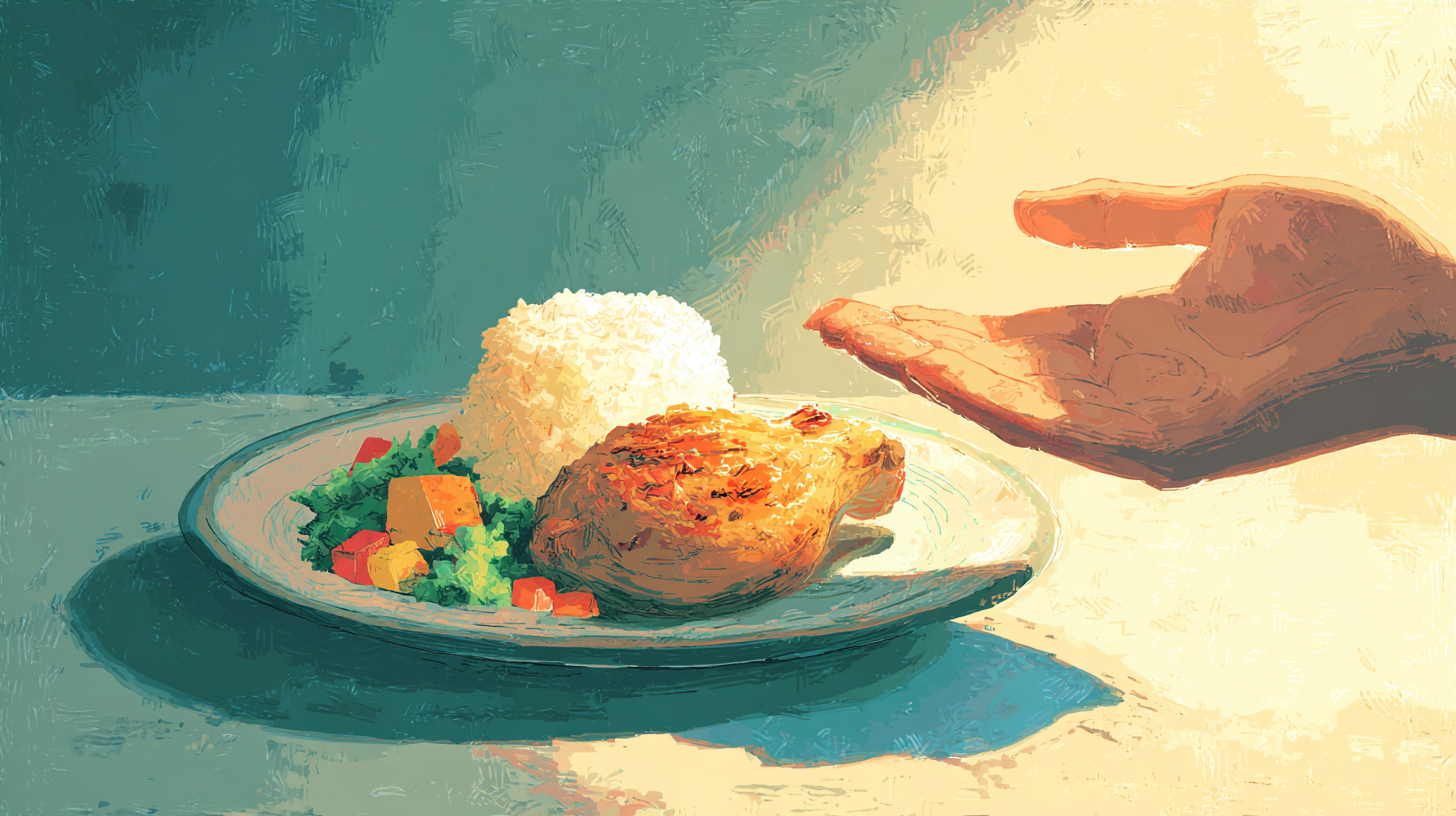
Now, knowing the difference between portions and servings is helpful, but it still leaves you with a very practical question: when you’re standing in your kitchen, how do you know how much to put on your plate without weighing and measuring everything? Most of us are not going to pull out a food scale every time we eat. That’s where simple visual guides come in—little pictures you can carry around in your mind so portion control becomes almost automatic.
Think of your own hand as a built-in measuring tool. God has given you a guide that is always with you, perfectly sized to your body. For many foods, your hand provides a reasonable estimate of what one portion should look like for you, not for a lab or a food company, but for your daily use at the table.
For example, a portion of meat or other protein foods is often described as about the size of the palm of your hand (not counting the fingers) and about the thickness of your little finger. For most adults, that works out to roughly 3–4 ounces of cooked lean meat, fish, or tofu. If your chicken breast covers your whole palm and spills over your fingers, you can be fairly sure you are eating more than one portion, even if the restaurant calls it a “single serving.”
For carbohydrate-rich foods like rice, pasta, or cooked cereal, a cupped hand can be your guide. One cupped hand of cooked grains is roughly 1/2 cup to 3/4 cup for many people, which is close to one standard serving. If you look down at your plate and see a mound of rice that looks more like two or three cupped hands, you can quietly note that your portion has grown far beyond a simple, moderate amount.
Fats and oils, which are so easy to overuse, can also be judged with the hand. One thumb—just the part from the knuckle to the tip—approximates about a tablespoon. So a thumb of peanut butter on your bread or a thumb of salad dressing on your greens is a fair starting point. When the salad leaves are drowning in dressing, or the toast is thick with nut butter beyond that simple thumb’s worth, it is a sign that the appetite is asking for more than the body needs.
Then there is the humble handful. A small closed handful of nuts or seeds—about what fits naturally when you curl your fingers in—is close to one ounce. That is usually one reasonable portion, rich in energy and nutrients. If your “snack” looks more like three or four big handfuls, what was meant to be a healthful addition quickly becomes a burden of excess calories, even though nuts themselves are a wholesome food when used with restraint.
Another easy picture is the plate itself. Imagine your plate divided in your mind into sections. For a main meal, a simple guide is to fill half the plate with vegetables and fruit, one quarter with whole grains or starchy vegetables, and one quarter with protein foods. The eye becomes trained to expect this balance. If your plate is half filled with meat and cheese, and only a few lonely vegetables appear at the edge, you can see at a glance that the harmony has been disturbed, even before you take a bite.
Some people find it helpful to think in terms of common everyday objects. A medium fruit like an apple or orange is roughly the size of a baseball. A half-cup of cooked vegetables or grains looks like half a baseball. A serving of cheese is about the size of a pair of dice or maybe two stacked together. When you see a slice of cheese draped thickly over a burger, much larger than that small block, you know without a scale that the portion has crept upward.
Try imagining these pictures as you prepare food. When you spoon oatmeal into the bowl, pause and mentally compare: “Does this look like about one baseball of cooked cereal, or two?” When you serve potatoes, ask, “Does this resemble half a baseball, or am I carving out a whole one and more?” These simple checks keep you alert, and over time, your sense of what is “enough” becomes more trustworthy and aligned with good nutrition.
Restaurants and packaged foods often work against this quiet training by presenting portions that are far larger than these visual guides. A plate of pasta that would never fit into your cupped hand, a steak that would require two palms side by side, a soda that holds the volume of several baseballs of liquid sugar—these are the modern “norms.” If you rely only on what others set before you, your eye will be educated by excess. But when you carry your own visual standards in mind, you gain the courage to eat differently, even when the crowd expects more.
You might be thinking, “All this sounds fine in theory, but I cook for a family—how do I use these guides in real life?” One way is to plan the meal with portions in mind right from the start. As you cook rice, you know a reasonable portion is about one cupped hand per person. If there are four of you, perhaps you cook just enough for four or five such portions, not eight or ten “just in case.” This simple decision limits what can end up on the plate, and it silently helps everyone at the table practice temperance.
At the table, you can talk gently with your children about these visual guides. Show them that half their plate should be bright with vegetables and fruit. Help them see that the piece of chicken should fit the palm, not be larger than their whole hand. In this way, healthy habits are taught not as strict rules, but as friendly pictures that the child can carry in mind long after they leave the home.
Visual guides are especially helpful when you are tired or hurried. On a rushed morning, you may not feel like calculating grams and ounces, but you can still glance at your bowl and ask, “Is this about one cupped hand of cereal, or has it become two?” In the evening, when you are most tempted to eat without thinking, you can look at your plate and quietly rearrange it until half is vegetables, and the meat is trimmed down to that simple palm-sized portion. These small acts of attention guard the gateway to the body when willpower feels weakest.
Over time, this way of seeing becomes almost second nature. Your eye begins to notice when the cup at a café is much larger than a standard 8-ounce cup. You recognize that a bakery muffin is bigger than a baseball and probably counts as two or three portions of grain and sugar. Instead of being swept along, you are able to say, “This is more than I need; I will share it,” or, “I will eat half now and save the rest.” The pictures in your mind give you freedom from the pressure of the portion on the plate.
None of these guides are meant to be chains, binding you in fear, but rather lamps, shedding light on your choices. They do not replace listening to your body’s true hunger and fullness, but they help retrain that inner voice, which has too often been schooled by years of oversized plates and endless refills. As you learn to see your food through these simple visual comparisons—your hand, your plate, the baseball, the dice—you give yourself a more faithful compass for daily eating, one that quietly supports your health, your strength, and your purpose in life.
Portion recommendations for different food groups
If you and I were to sit together at your kitchen table and speak plainly of food, I would not begin by handing you a long list of numbers and rules. Such things may be useful, but they are poor companions if they stand alone. Instead, let us look at the different kinds of foods the Lord has provided—fruits, vegetables, grains, proteins, and dairy or their worthy substitutes—and consider how much of each usually brings strength without excess. The goal is not to turn your meals into a ledger of calories, but to give gentle boundaries within which you may eat with freedom, joy, and good sense.
Modern guidance, such as the Dietary Guidelines for Americans, suggests general daily amounts for each food group, tailored by age, sex, and activity level, because our needs are not all alike [1]. Yet most adults are encouraged toward a pattern that includes abundant vegetables and fruits, moderate amounts of whole grains, and measured portions of protein and dairy or fortified alternatives. Within that broad counsel, you and I may find a pattern that suits our own frame and labor, while remembering that temperance is a friend to all, whether the body is large or small, young or growing older.
Let us begin with vegetables, for they are too often pushed to the corners of the plate and of our attention, though they are the most cheerful allies of good health. Many guidelines encourage at least 2½ to 3 cups of vegetables each day for most adults, with variety in color and type—dark green, red and orange, beans and peas, and other vegetables besides [1]. One cup might be a salad bowl loosely filled with leafy greens, or a heap of cooked broccoli, carrots, or green beans. If you aim for half your plate to be vegetables at two meals, you will generally reach this amount without much counting. Their portions may be generous, for they are rich in nutrients and modest in energy, and they help with portion control by leaving less room for heavier foods.
Fruits, like dear companions to vegetables, are also encouraged, though in slightly smaller measure. A common recommendation for adults is about 1½ to 2 cups of fruit a day [1]. This might look like an apple at breakfast and a cup of berries after supper, or a banana in the morning and an orange in the afternoon. One small whole fruit—about the size of a baseball—usually counts as one serving, while half a large fruit may do the same. A half-cup of cut fruit or unsweetened canned fruit is another serving. When fruit is taken mostly in its whole form, with its natural fiber, it blesses digestion, steadies blood sugar, and satisfies the sweet tooth in a kinder way than cakes and candies ever can.
Grains deserve particular attention, for here modern appetites often run ahead of wisdom. The guidelines commonly suggest about 5 to 8 ounce-equivalents of grains per day for adults, depending on age, sex, and activity, with at least half of them coming from whole grains rather than refined ones [1]. An ounce-equivalent of grain is roughly one slice of bread, one small tortilla, or about ½ cup of cooked oatmeal, rice, or pasta. Thus, two slices of whole-grain bread at breakfast and a cup of cooked brown rice at dinner already bring you to three or four ounce-equivalents. When plates are crowned with great heaps of white pasta or endless baskets of bread, it is easy to double or triple this amount without a thought, and then wonder why the body grows heavy.
Whole grains—oats, barley, brown rice, quinoa, whole-wheat bread, and others—bring more fiber, vitamins, and minerals than their refined cousins, and they are linked with lower risk of heart disease, type 2 diabetes, and certain cancers [2]. You need not fear grains, but choose mostly whole ones, and keep the portions modest, especially if the day’s labor is light. Many have found that by simply replacing refined grains with whole grains and keeping to the recommended range, weight and energy both improve, without any other severe change in their diet.
Protein foods are often the pride of the plate, particularly in homes where strength and vigor are desired, yet more is not always better. For many adults, about 5 to 6½ ounce-equivalents of protein foods each day is sufficient, though highly active persons may need somewhat more [1]. An ounce-equivalent in this group might be 1 ounce of cooked meat, poultry, or fish; ¼ cup of cooked beans or lentils; 1 egg; a tablespoon of peanut butter; or a small handful of nuts or seeds. When you recall that a palm-sized piece of cooked meat is roughly 3–4 ounces, you see at once how easily a single generous steak can supply most of your day’s animal protein at once.
It is wise to let plant proteins—beans, lentils, peas, soy products, nuts, and seeds—share the stage with animal foods. Research suggests that choosing plant proteins more often, especially in place of red and processed meats, may reduce the risk of heart disease and help maintain a healthy weight [3]. A cup of cooked beans might count as about 2–3 ounce-equivalents, and it brings with it ample fiber and a gentle, steady release of energy. By planning several meals each week where beans or lentils are the centerpiece, you may easily remain within the recommended protein range without feeling deprived.
Dairy and fortified alternatives stand in their own small circle, for they are valued chiefly for their calcium, vitamin D, and protein. Many guidelines suggest about 3 cup-equivalents per day for most adults and older children, though individual needs may differ [1]. One cup of milk or fortified soy beverage, 1 cup of yogurt, or 1½ ounces of natural cheese each count as one equivalent. A slice of cheese about the size of two stacked dice is roughly 1 ounce; two such slices approach a whole dairy serving. It is surprisingly easy, with lavish cheese on sandwiches and casseroles, to slip beyond three servings without noticing, bringing in more saturated fat and calories than the body can happily manage.
For those who do not take dairy, fortified plant milks (such as soy, pea, or almond milk) and fortified yogurts can provide similar nutrients when chosen with care. Look for versions that are unsweetened or lightly sweetened, and fortified with calcium and vitamin D. The portion guidance is usually the same—a cup at a time. In this way, you can keep your bones supplied without inviting sugar and excess fat to the table as unwanted guests.
The fats and oils we use in cooking and at the table may look small, but they are powerful. Most adults are encouraged to stay within about 5 to 7 teaspoons of oils a day, aside from the fats naturally present in foods like nuts, seeds, and fish [1]. A teaspoon of oil is roughly the size of the tip of your thumb, while a tablespoon, common in dressings and spreads, is the length from knuckle to tip. When you dress a salad with several generous spoonfuls of oil, or fry foods in deep pools of fat, you can easily double or triple your day’s recommended oils at a single meal. Choosing mostly unsaturated fats—olive oil, canola oil, nuts, seeds, and avocados—while limiting saturated and trans fats, has been repeatedly associated with better heart health [4].
Sugars and sweets, though not given generous recommended amounts, are addressed chiefly by limits rather than quotas. The Dietary Guidelines advise that added sugars should make up less than 10% of daily calories, and many health organizations suggest even lower targets for some people, particularly those at risk for diabetes or heart disease [1,5]. For a person eating 2,000 calories a day, 10% would be about 50 grams of added sugar, which is roughly 12 teaspoons. Yet a single large sweetened drink or a slice of rich dessert can consume this allowance in one swift pleasure. If you choose to enjoy sweets, keeping the portions small—a cookie or two, a small square of chocolate, a modest slice shared with another—helps preserve both joy and health.
Beverages as a whole deserve a moment’s notice, for they may add energy without satisfying hunger. Water should be the main drink at table and between meals, with unsweetened tea or coffee as occasional companions if they agree with your constitution. Fruit juices, even 100% juice, are best kept to small portions—no more than 4–8 ounces a day for most adults—because they deliver the fruit’s sugar without its fiber. Sugary drinks, energy beverages, and sweetened coffees can easily overwhelm all careful portion control in other areas if they are not restrained. To treat them as rare indulgences rather than daily necessities is a kindness to your heart, your teeth, and your blood sugar.
It may seem at first that these varied recommendations form a sort of crowded assembly: cups of vegetables here, ounce-equivalents of grains there, teaspoons of oil in another corner. Yet if we look at them with a calm mind, we see that they all press us toward the same simple pattern: abundant plants, modest grains (preferably whole), measured proteins, limited sweets and added fats. When your plate at most meals shows this harmony—half filled with vegetables and fruit, a quarter with grains, and a quarter with protein, plus a little dairy or fortified alternative on the side—you are, in truth, walking very close to the counsel of the experts without needing to calculate every bite.
Over time, these recommended portions do more than guide a single meal; they train the appetite itself. As you repeatedly choose, for example, one palm-sized portion of protein instead of two, one cup of cooked grain instead of a towering mound, and a generous helping of vegetables at each meal, your sense of “enough” slowly moves into better alignment with what truly nourishes. Research has shown that such steady patterns, practiced day after day, can lower the risk of chronic diseases and support a healthy weight more reliably than any short-lived, extreme diet ever could [2–5]. In the end, it is not a single plate but the habit of many plates that shapes our health.
This is the quiet beauty of sound nutrition: it does not demand that you starve or count every crumb, but invites you to order your food groups and their portions in a way that honors both the body and the life you wish to live. As you become more familiar with what is reasonable for each kind of food, the work grows easier. You find that you can look at a meal and know, almost at a glance, whether it sits within the gentle borders set for you. And when you sometimes choose to step beyond those borders for a special occasion, you do so with open eyes, not in confusion, and you return to your usual pattern with peace.
So, my friend, think of these portion recommendations not as a stern master, but as a kindly tutor. Vegetables and fruits ask to be plentiful; grains and proteins request moderation; fats and sweets plead for thrift. To heed their different voices is to cultivate healthy habits that do not change with every new fashion, but rest on principles that have been tried and found faithful. In that way, your table may become a place where both taste and prudence are satisfied, and where each day’s meals quietly support the work and joy appointed to you.
References
[1] US Department of Agriculture and US Department of Health and Human Services. “Dietary Guidelines for Americans 2020–2025.”
[2] Aune, D. et al. “Whole grain consumption and risk of cardiovascular disease, cancer, and all cause and cause specific mortality: systematic review and dose-response meta-analysis of prospective studies.” BMJ, 2016.
[3] Satija, A. et al. “Plant-Based Dietary Patterns and Incidence of Type 2 Diabetes in US Men and Women.” PLOS Medicine, 2016.
[4] Mensink, R. P. “Effects of saturated fatty acids on serum lipids and lipoproteins: a systematic review and regression analysis.” World Health Organization, 2016.
[5] Johnson, R. K. et al. “Dietary Sugars Intake and Cardiovascular Health: A Scientific Statement From the American Heart Association.” Circulation, 2009.
Common portion size mistakes to avoid
The trouble rarely comes from one wild feast. It comes from small mistakes, made day after day, until they feel like the way things have always been. Portion sizes work the same way. No one sets out to overeat on purpose. We are simply trained by plates, packages, and habits that grow larger than our true needs. If we want better health without living on a scale, we must learn to see these quiet errors and correct them before they harden into our story.
One of the most common mistakes is trusting the plate instead of your body. The plate is big, so the portion grows to match it. This is called the “portion size effect,” and it has been shown again and again: when people are served more food, they eat more, often without feeling any more satisfied afterward [1]. At home, restaurants, potlucks—wherever the dish is generous, our spoons follow suit. Large dinner plates, deep bowls, and oversized glasses all whisper the same lie: “This is one normal portion.” It is not. It is just one big dish.
Modern dishes have grown stealthily over the years. A plate that once measured 9 inches now often reaches 11 or 12. If you fill that plate the way your parents did their smaller ones, you may be eating 20–40% more without realizing it. The mistake is not in the food itself, but in letting the size of the plate decide the size of the meal. Smaller plates and bowls can quietly help restore portion control. The food looks ample, though the amount is more reasonable, and your mind is less likely to cry out that you have been robbed.
Another mistake is believing the package instead of the label. A bag of chips that fits your hand, a muffin that sits alone in its wrapper, a bottle of soda with a single cap—these things look like “one.” But the Nutrition Facts label often tells another story: two, sometimes three servings inside that friendly shell. Studies have found that people tend to treat a single package as a single portion, regardless of what the label says, and then underestimate how much they have eaten [2]. When that happens, even a person who thinks they are careful with their nutrition may be doubling or tripling their intended intake.
To avoid this, get into the habit of checking the number of servings per container before you open it. If there are three, you have a decision to make. Will you share it? Will you eat just part and save the rest? Or will you go ahead and eat it all, but at least do so knowing it counts as three portions, not one? The mistake is not in sometimes enjoying the whole thing, but in pretending it is “just a snack” when, in truth, it is more like a full meal in disguise.
Then there is the bottomless bowl—the meal that never seems to end because you never see the end. Think of chips served from a giant family bag, popcorn from a deep bowl, or pasta from a large pot placed in the center of the table. Research has shown that when bowls or serving dishes are constantly refilled, people eat far more and still underestimate how much they have taken [3]. No one notices the refills. The hand simply moves from plate to bowl and back again, as if under a spell.
This kind of eating is especially common when we are distracted—watching television, scrolling on the phone, or talking intently with friends. The attention leaves the plate, and the body is fed by habit, not by hunger. The mistake here is not conversation or fellowship; those are gifts. The mistake is eating without sight, as if the food were a side thought, when in truth it is shaping our health in quiet ways. Serving a fixed portion on a plate and leaving the rest in the kitchen is a simple guard against the endless bowl.
Many people also misjudge certain foods because they look innocent. Nuts, granola, cheese, dried fruit, and oils are wholesome when used wisely, but they are dense with energy. A small handful of nuts, a thumb of oil, a dice-sized piece of cheese—these are reasonable portions. But the hand grows bold. Soon the handful becomes a fistful, the drizzle becomes a pour, the cheese is sliced thick and layered heavy. Because these foods wear the mask of “healthy,” the mind forgets that their portions must still be measured if we want our weight and blood fats to remain steady [4].
This is not a call to fear such foods. They are rich in good fats, protein, and other nutrients. The mistake is letting them slip into the “free food” category, eaten with no thought for amount. A bowl of granola eaten like cold cereal, filling the dish to the brim, may contain two or three standard servings, sometimes more. A salad drowned in dressing may carry more calories from oil than from vegetables. When these foods are taken in modest amounts, they support healthy habits; when the portions swell, they quietly undermine our best intentions.
Restaurant meals bring their own set of pitfalls. Plates come piled high and crowned with sauces. Bread arrives “on the house.” Refills on drinks are “complimentary.” All these little kindnesses carry a hidden cost. Typical restaurant entrées often contain more than a full day’s worth of sodium, and 60–100% of the calories an average adult needs in an entire day, especially when sides and dessert are included [5]. Yet because everyone around us is eating the same way, it feels ordinary, even modest.
The mistake, again, is not in ever eating out. The error lies in treating every restaurant plate as the proper size for one person. In truth, many of these dishes could easily feed two. Splitting an entrée, boxing up half at the start of the meal, or simply leaving food on the plate when satisfied are all ways to step out of the crowd’s rhythm. But when we let the restaurant determine what “one portion” means, we slowly train our eyes and stomach to crave more than is kind to our hearts and waists.
Liquid calories present another quiet trap. The body does not register calories from liquids as firmly as those from solid food, so we may drink a great deal without feeling less hungry later [6]. Sugary sodas, sweet teas, flavored coffees, energy drinks, and even large glasses of juice slide down easily, and the portions are rarely small. A 20-ounce soda holds the sugar of many teaspoons. A large flavored coffee can add the calories of a small meal to your day. Because they do not require chewing and disappear quickly, we treat them like “just something to drink,” forgetting that they are, in fact, food.
Even healthier drinks can cause trouble when the portions swell. Smoothies made with fruit, yogurt, and nut butter may be full of good things, but a giant cup can quietly pack in several pieces of fruit and multiple tablespoons of fat. The tongue says, “This is a health drink,” and so the brain gives no thought to limits. The wiser way is to treat such drinks like any other concentrated food: enjoy them from a modest glass, not a jug, and count them as part of your meal, not a harmless extra.
Another common slip is ignoring the difference between hunger and habit. Many of us eat because the clock says it is time, because others are eating, or because food is near at hand—not because the body has asked. Over years, the sense of physical hunger grows faint, like a voice drowned out by the noise of routine. When that happens, we often finish everything before us simply because “that is what I always do,” never pausing to ask if we are still hungry at all.
This mistake is often tied to how we were raised. Many were taught to “clean your plate” out of respect for the one who cooked and compassion for those who lack food. The intention was noble, but the effect can be harmful in a world of abundance. To honor the cook and the hungry does not require us to overfill our own stomachs. Better to serve ourselves less, eat until we are satisfied, and save leftovers for another meal. Studies on mindful eating show that simply pausing to check in with hunger and fullness can help reduce overeating and support weight management without strict dieting [7].
Comfort eating is a close cousin to this habit. Food becomes a balm for stress, loneliness, or fatigue. We reach for snacks, not because our bodies are empty, but because our hearts are heavy. In such moments, portion sizes often vanish from sight. The whole bag, the half pan of brownies, the late-night bowl that becomes three—these are not really about hunger at all. No guideline can fully untangle this knot, but recognizing that emotional eating often leads to unmeasured portions is a first step. When you see it clearly, you can begin to reach for other comforts: a walk, a talk with a friend, a quiet prayer, a book that lifts the mind.
A further mistake is trusting “low-fat,” “organic,” or “natural” labels as permission to eat freely. These words speak about quality, not quantity. A low-fat cookie may still carry as many calories as a regular one, with extra sugar added for taste. Organic chips are still chips. Natural ice cream is still ice cream. Research has found that “health halos” around such labels can cause people to underestimate calories and eat larger portions than they otherwise would [8]. The package may indeed contain better ingredients, but it does not remove the need for sober portions.
Finally, we often fail to adjust our portions when life changes. The body that once labored in the field or on the job site may now spend long hours at a desk. The woman who once burned many calories in youth may need less as the years and hormones change. Yet the plate remains the same. If anything, it grows, because income is greater and food is easier to obtain. When energy out declines and portions stay high, weight and blood sugar creep upward. This slow mismatch between intake and need is one of the main engines of modern chronic disease [9].
To guard against this, take honest note of your season of life and daily movement. A day at a desk does not require the same fuel as a day in the field. On light days, let your portions be lighter—less grain, less fat, perhaps a bit less protein—while keeping vegetables and other high-fiber foods abundant. As activity increases, you can loosen the belt slightly. The mistake is in keeping one fixed portion style for all seasons, as if the body were a machine that never changes.
These common errors do not make you weak or strange; they make you human in a world that constantly urges you to eat more than you need. But you are not helpless before them. By learning to spot large plates, sneaky packages, endless bowls, dense “healthy” foods, oversized drinks, mindless eating, health halos, and unchanging habits, you reclaim the power to decide, one portion at a time. Clarity is the first mercy. Once you see the traps, you can walk around them, not by starving yourself, but by choosing enough and letting “enough” be plenty.
References
[1] Rolls, B. J. “What is the role of portion control in weight management?” International Journal of Obesity, 2014.
[2] Wansink, B., & Chandon, P. “Can ‘low-fat’ nutrition labels lead to obesity?” Journal of Marketing Research, 2006.
[3] Wansink, B., et al. “Bottomless bowls: why visual cues of portion size may influence intake.” Obesity Research, 2005.
[4] Blundell, J. E., et al. “High-fat and low-fat (behavioral) phenotypes: biology or environment?” Proceedings of the Nutrition Society, 2005.
[5] Young, L. R., & Nestle, M. “Portion sizes and obesity: responses of fast-food companies.” Journal of Public Health Policy, 2007.
[6] Malik, V. S., et al. “Sugar-sweetened beverages and weight gain in children and adults: a systematic review and meta-analysis.” American Journal of Clinical Nutrition, 2013.
[7] Mason, A. E., et al. “A systematic review and meta-analysis of randomized controlled trials of mindfulness-based interventions for weight loss and obesity-related eating behaviors.” Obesity Reviews, 2018.
[8] Schuldt, J. P., & Schwarz, N. “The ‘organic’ path to obesity? Organic claims influence calorie judgments and exercise recommendations.” Judgment and Decision Making, 2010.
[9] Hill, J. O., & Peters, J. C. “Environmental contributions to the obesity epidemic.” Science, 1998.
Practical tips for controlling portions
Portion control becomes far more practical when you reshape your environment instead of relying only on willpower. One of the simplest changes is to choose smaller dishes. Using 8–9 inch dinner plates instead of 11–12 inch ones naturally trims portions without making the plate look bare. Similarly, shallow bowls and smaller glasses help you serve reasonable amounts of cereal, soup, and drinks. Ask yourself: if your dishes are silently teaching you what “normal” looks like, what have they been teaching you so far?
Pre-portioning foods is another quiet but powerful tool. When you come home with a large bag of nuts, a family pack of crackers, or a big container of yogurt, divide them into small containers or bags that hold a single reasonable portion. Then, when you want a snack, you take one portion instead of eating straight from the package. This practice interrupts mindless eating and forces a tiny moment of choice: “Do I really want another portion enough to go and get it?” It also helps children learn what an appropriate snack looks like, rather than leaving them to guess from a giant box.
Planning your meals, even in a simple way, can spare you from hasty portions driven by hunger and fatigue. When you know ahead of time what you will eat for the main meals of the day, you can choose recipes and amounts that fit your needs instead of grabbing whatever is largest and fastest. Batch cooking can serve you here: cook a pot of beans, a pan of roasted vegetables, and a pot of brown rice, then divide them into lunch-sized containers with half the container vegetables, a quarter grains, and a quarter protein. In a moment of weakness, the work is already done; you only have to heat and eat.
Slowing down and paying attention to hunger and fullness signals may be one of the most overlooked forms of portion control. Before you eat, pause for a few breaths and quietly rate your hunger on a simple scale in your mind—perhaps from 1 (very hungry) to 10 (uncomfortably full). Aim to begin eating around a 3 or 4 and to stop around a 6 or 7, when you feel satisfied but not stuffed. This practice trains you to notice the difference between physical hunger and other urges—boredom, stress, habit—and to let your body, not the clock or the plate, shape your portions.
Eating without distractions strengthens this inner awareness. Put aside screens, newspapers, and intense tasks during meals whenever you can, and focus on the food itself—the flavor, texture, and aroma. Set down your fork between bites, chew thoroughly, and notice when the food becomes less pleasurable, or when you sense a gentle fullness rising. Many find that simply by eating mindfully, they naturally choose smaller portions and feel more satisfied, as if the same food has become richer because it was truly tasted.
Drinking water wisely can also help guide portions. Sometimes what feels like hunger is quietly thirst, and a glass of water taken 15–20 minutes before a meal can clarify the difference. Sipping water throughout the day, and choosing it as your main drink, prevents sugary beverages from adding “stealth” calories that confuse your body’s cues. During meals, small sips can slow your pace and give your stomach time to sense fullness. You might even ask yourself, “Am I truly hungry, or is my body simply asking for water?”
When you eat away from home, advance planning protects you from oversized restaurant portions. Look at the menu ahead of time if possible and choose what you will order before you are surrounded by tempting sights and smells. Decide in advance to share an entrée, ask for a half portion if available, or request a box at the beginning and set aside half your meal before you start eating. Many people find that when they commit to this plan before sitting down, they feel freer and less torn once the plate arrives heaped with food.
Buffet lines and potlucks invite special care. Walk the entire line before putting anything on your plate, so you can see all your options and choose what will truly satisfy you. Begin by filling half your plate with vegetables or salads that are lightly dressed, then choose one or two starches and one protein in modest amounts. Stand back and look at your plate before you sit: is it balanced, or crowded with rich dishes? This moment of reflection turns a chaotic spread into a thoughtful meal.
At home, arrange your kitchen so that healthier choices are easiest to reach and see. Keep fresh fruit in a visible bowl on the counter and cut vegetables prepared in clear containers in the front of the refrigerator. Place less wholesome snacks in opaque containers on higher shelves or out of the main traffic path. When the sight line favors wholesome foods, your “default” portions shift in a better direction without argument or strain.
Using simple measuring tools for a short season can sharpen your eye and judgment. For a week or two, measure out your usual cereal, pasta, rice, or juice and compare it to the serving size suggested on labels or guidelines. You may be surprised at how your “normal” compares. This is not about living forever with a scale in your hand, but about retraining your sense of what an honest portion looks like, so that later you can estimate with greater accuracy and peace.
Healthy habits around cooking methods also influence how much you eat. Grilling, steaming, baking, or roasting with little added fat keeps dishes lighter, so that appropriate portions satisfy without overwhelming your body. When food is fried or heavily sauced, even a modest portion may be very rich, leading you either to feel sluggish or, paradoxically, to crave more. Try experimenting with herbs, spices, citrus, vinegar, and broths to build flavor without relying on large amounts of butter, cheese, or sugar-laden sauces—and notice how this changes the amount you need to feel satisfied.
Snacks deserve deliberate boundaries, especially in a world that encourages constant nibbling. Decide ahead of time how many snacks you will normally have in a day—perhaps one or two—and what they will generally look like: a small handful of nuts and a piece of fruit, a yogurt, some cut vegetables and hummus. Serve snacks on a plate or in a small bowl, not from a bag, and then put the package away before you begin eating. Ask yourself, “Is this snack bridging me gently to the next meal, or is it becoming a second lunch in disguise?”
Teaching children portion control in gentle, practical ways sets them on a safer path before poor patterns are fully formed. Offer them small portions first and reassure them that they may have more if they are still hungry after finishing. Use your visual guides—the palm for protein, the cupped hand for grains, half the plate for fruits and vegetables—to help them see what a balanced meal looks like. Invite them to help serve the family meal, and talk about why you are choosing these amounts, so that the lesson sinks deeper than any rule ever could.
Self-compassion is an often forgotten, but vital, part of changing how you eat. There will be days when you misjudge your hunger, eat more than you planned, or give in to the pull of a large portion at a celebration. Instead of condemning yourself, treat each meal as another chance to learn. Ask calmly, “What led to that choice? Was I tired, rushed, upset, or unprepared?” Then use the answer to adjust your surroundings or routines. Over time, you become a thoughtful student of your own patterns rather than a strict judge, and your portion control grows steadier as a result.
Above all, consider the deeper reasons you want to shape your portions more wisely. Is it to have more energy for your work, to be able to play with your children or grandchildren, to serve more fully in your community, or to carry out the purpose you believe God has for your life? When your reasons are rooted in meaning rather than vanity, your daily choices gain weight and dignity. Each time you choose a smaller portion, pause to remember what you are saying “yes” to, not only what you are saying “no” to.
As you reflect on these practices, allow yourself to be curious. Which of these ideas stirs something in you? Which feels challenging, and why? The way you eat today is the fruit of years of cues, customs, and unspoken beliefs. You are free to question them. You are free to ask whether the portions you have always accepted actually serve the life you long to live. Let that question stay with you at the grocery store, at the stove, at the table—and see what begins to change when you give it honest attention.
- How do I know what portion size is right for me?
- Start with general guidelines—such as a palm-sized portion of protein, a cupped hand of grains, and half your plate as vegetables—and then notice how your body responds. If you feel satisfied for several hours without feeling heavy or overly full, you are close to the right amount; if you are still very hungry or uncomfortably stuffed, adjust slightly next time.
- Do I need to weigh and measure all my food to practice portion control?
- Weighing and measuring can be helpful for a short time to retrain your eye, but most people do not need to do this forever. Once you have a sense of standard servings, visual cues like your hand, your plate, and common objects (a baseball, a pair of dice) can guide you in everyday situations.
- Can I still eat my favorite foods if I’m trying to manage my portions?
- Yes, most people can continue to enjoy their favorite foods in smaller amounts and less often. Focus on keeping portions modest, surrounding those foods with plenty of vegetables, fruits, and whole grains, and savoring them slowly so that a little truly feels like enough.
- How does eating out affect my portion sizes?
- Restaurant portions are often much larger than standard servings, especially for pastas, meats, and desserts. To protect yourself, consider sharing dishes, asking for a half portion, or boxing up part of the meal before you begin eating, so that the plate in front of you reflects what you actually intend to consume.
- Is “healthy” food still a problem if I eat large portions of it?
- Even wholesome foods can undermine your goals if the portions are consistently too large, especially calorie-dense items like nuts, oils, cheese, and granola. Quality and quantity both matter; combining nutritious choices with reasonable amounts is what best supports long-term healthy habits.
- What’s the difference between listening to my body and just eating whatever I want?
- Listening to your body means paying attention to true physical hunger and fullness cues, not simply following cravings, emotions, or habits. It involves slowing down, checking in with yourself before and during meals, and sometimes choosing to stop eating even when food remains on the plate.
- How long does it take to reset my sense of a “normal” portion?
- Many people notice change within a few weeks of consistently serving smaller portions and eating mindfully, though deeper habits may take several months to fully shift. As your eyes and stomach grow accustomed to new amounts, what once felt small begins to feel sufficient, and your appetite settles into a healthier rhythm.
Ashland Sabbath Chapel Ministries
Beside our live streamed church services, all are welcome to attend our church in person each Saturday beginning 10:00 AM Central Time by going to 2425 Owens Rd., Ashland, AL 36251. There is no cost and any donations are strictly voluntary.
For questions, call +2563547124.